How Much of You Is Fascia? About a Fifth, and Your Training Ignores It


Training builds the engine. Nobody trains the transmission.
You can spend years building strength. Bigger lifts, more muscle, a better engine. And still feel that something is missing when you sprint, cut, jump or rotate. The force is there. It just doesn't arrive where you need it.
The part that moves force from one place to the next is one of the largest tissue systems in your body. It wraps every muscle, links every joint and works like a spring every time you hit the ground. It is called fascia. And most training acts as if it weren't there.
Fascia is the connective tissue network that wraps, links and holds together your muscles, tendons and joints. It is estimated at around a fifth of your body weight. It transfers force between muscles and stores elastic energy, and it adapts to the way you load it.
How much of you is fascia?
More than most athletes would guess. Fascia sits around every muscle fiber, around every bundle of fibers and around every muscle. It continues into tendons, ligaments and joint capsules, and it forms the sheets that connect one muscle group to the next. For a long time, anatomy treated it as packing material, something to cut away to get a clear view of the muscles underneath.
A common estimate puts fascia at around 20 percent of your body weight [1]. For a 75 kg athlete, that is roughly 15 kg. Numbers above 20 kg circulate online, and for a heavier athlete they are in the same range. Nobody has ever weighed all of it, because there is no clean line where fascia ends and the next tissue begins. So every number is an estimate.
The exact figure matters less than the order of magnitude. This is not a thin film. It is a full system, and you carry it into every session.
One network, not separate parts
Your training plan splits the body into parts: chest, back, legs, core. Fascia doesn't. Sports medicine researchers describe it as one fascial system, a continuous three-dimensional network that runs through the whole body [2].
A good example sits at your hip. In dissections, the gluteus maximus attached so broadly to the fascia of the thigh that the iliotibial band can be seen as its tendon [5]. Your strongest hip muscle pulls on a sheet that runs down to your knee. The researchers point out that this connection could help explain how force travels from your back, through your hip, to your knee [5].
Some researchers describe the whole body as a tension network, a model called biotensegrity. Bones act as spacers, connective tissue as the cables that keep everything under tension. It is a model, not a measurement. But it describes what athletes feel every day: pull on one part, and the whole system answers.
Your body is a connected system that stores, transfers and expresses force.
Fascia transfers force
Here is where it gets interesting for performance. Force does not only run from a muscle straight into its tendon. Part of it moves sideways, into the surrounding connective tissue and on to neighboring muscles.
In animal studies with the surrounding fascia left intact, the force measured at the two ends of the same muscle differed by up to about 23 percent. The connective tissue carried part of the load away [3].
Strength training builds how much force you can produce. But athletic performance depends on how effectively that force travels through your body and into the ground. Roughly a fifth of your force is transmitted through connective tissue rather than the tendon, yet most training doesn't load that layer deliberately. That is the missing link between being strong and being able to use that strength in motion.
Fascia is your spring
Watch a great sprinter or a point guard change direction. It looks easy. That is the elastic system at work.
When researchers watched the calf with ultrasound during a countermovement, the quick dip before you push off, the muscle fibers worked almost without changing length. The tendon stretched and recoiled instead, storing energy on the way down and giving it back on the way up [4]. The muscle held the position. The connective tissue did the bouncing.
Tendons and fascia are the elastic part of your body. When that spring works, movement has rebound: you hit the ground and come off it fast. When it doesn't, your muscles have to produce more of the work on their own. Athletes notice it: every rep feels like effort, the same muscles tire first, and nothing feels light.
That is why we call it the missing layer. Not because muscle doesn't matter. Because muscle alone is only half the system.
More on the spring: elastic recoil training and how to gain power without adding muscle.
Fascia makes up about a fifth of you. Our protocol trains it in every direction: 20 minutes, 5 times a week.
Start the protocol 14-day money-back guarantee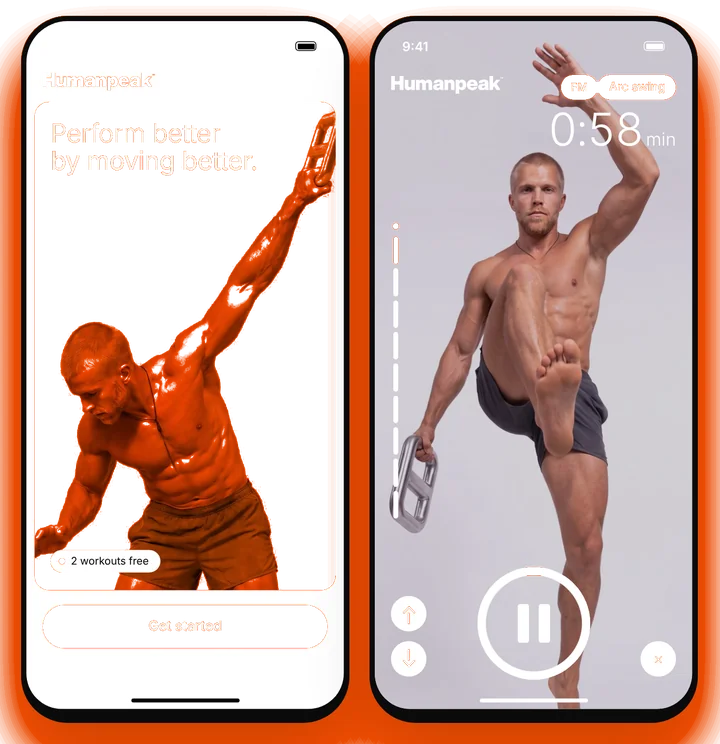
Fascia is not just packing material
Fascia is not only passive. It contains cells called myofibroblasts that can contract on their own [6]. The forces are small and slow, far too weak to stabilize your spine by themselves, but the researchers think they may influence how your body coordinates movement [6].
For training, the point is simple: fascia is living tissue. It senses, it reacts and it adapts. Which means it can be trained.
Why most training ignores it
Sport is multidirectional. Most training isn't.
Athletic movement happens through rotation, diagonal patterns, acceleration and changes of direction. Yet most strength training remains slow, isolated and largely sagittal: up and down, forward and back. Connective tissue adapts to the load it gets [2]. Give it one direction and it learns one direction.
Rolling and massage have their place. They can make tissue feel looser and reduce soreness for a while. But they work from the outside. Pressing changes how it feels. Loading changes what you can carry.
Fascia isn't trained by rolling on it. It's trained by loading it.
How to load your fascia
Five principles carry most of the effect:
- Every direction. Rotation, diagonals, lateral steps and changes of direction, because that is how your sport loads you.
- Elastic. Rhythm, rebound and quick turns from loading to unloading, so the spring learns to store and return energy.
- The whole chain. From the foot through the hip to the opposite shoulder. Force starts at the ground: how your feet put force into the ground.
- Variation. Your sport never asks for the same rep twice. Your training does. Change angle, tempo and range, so the system learns to adapt instead of repeat.
- Regular and progressive. Connective tissue adapts over weeks and months, not days [2]. Short, frequent sessions with a clear progression beat the occasional long one.
How Humanpeak trains the missing layer
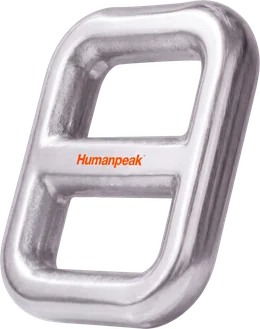
Humanpeak is built around these principles. The 12-Week Movement Protocol runs 5 workouts per week, about 20 minutes each, in three phases: Restore, Build, Perform. You train with the Humanpeak™ Movement Tool (2.2 kg). Every flow combines mobility, control and targeted fascial loading through multidirectional movement to train your body as one connected system.
It doesn't replace your training. It adds the layer your training leaves out. You've built strength. Now make it transfer.
The principles behind Humanpeak are established training science. Studies on the specific tool are still to come.
To start from the basics, read what fascia is, and why it matters for athletes.
Frequently asked questions
Humanpeak follows clear sourcing guidelines: we rely on peer-reviewed studies, scientific institutions and professional bodies, and aim for primary sources. Spotted an error? Write to us.
This article is for educational purposes only and does not replace medical advice. If you have symptoms, talk to a doctor.

Related articles


