The Posterior Oblique Sling: How Your Glute Powers the Opposite Shoulder


Training builds the engine. Nobody trains the transmission.
Your glute is one of the strongest muscles you have, and most programs train it like an engine: heavier hip thrusts, deeper squats, more muscle. That works for producing force. It says little about where that force goes next.
In a sprint stride, a throw or a swing, the glute's job doesn't end at the hip. Its pull runs into a sheet of fascia across the lower back and on to the opposite shoulder. That diagonal is the posterior oblique sling. Power doesn't only come from adding muscle. It also comes from how well the muscle you already have connects to the rest of you.
The posterior oblique sling is a diagonal line across the back of the body: the gluteus maximus on one side, the thoracolumbar fascia in the middle and the latissimus dorsi on the opposite side. It carries force between one leg and the opposite arm when you sprint, throw and rotate. Train it as a pattern, one hip driving and the opposite shoulder working, so more of the strength you've built shows up in the movement.
What is the posterior oblique sling?
Extend your right hip and pull your left arm down and back. Both ends load the same sheet of tissue across your lower back, from opposite corners. That is the posterior oblique sling: your glute on one side, the thoracolumbar fascia in the middle, your lat on the other side.
The model comes from dissection research on the pelvis. Researchers pulled on individual muscles and tracked the fascia of the lower back. The lat, the glute and the back extensors all tensioned the same layer, and below the lower lumbar spine that tension crossed to the opposite side [1]. The authors described it as an integrated system between spine, pelvis, legs and arms [1].
A sling is not one muscle. It describes how several structures work as one unit during a task. Here, the task is any movement in which one leg and the opposite arm work together, which covers most of sport.
Your glute pulls on more than bone
The glute is usually drawn as a muscle that runs from the pelvis to the thigh bone. The tissue tells a bigger story. In dissections, the gluteus maximus attached so broadly into the fascia of the thigh that the iliotibial band can be seen as its tendon [2]. The researchers point out that this connection could help explain how force travels from the fascia of the back, through the hip, down to the knee [2].
So your strongest hip muscle pulls on fascia in two directions. Down the thigh toward the knee, and up into the sheet across the lower back toward the opposite shoulder [1][2]. When you train the glute only as an isolated muscle, you build its size and strength. The connections it works through get far less attention.
Force crosses the diagonal
Researchers have tested the sling in living people. In 37 participants, they tensioned the lat and measured the opposite hip. When the lat contracted, the resting position of that hip shifted and its stiffness rose [3]. Force applied at one shoulder showed up on the other side of the pelvis.
A later study repeated the test with 54 runners and non-runners. Contracting the lat stiffened the lower back and changed the opposite hip in both groups. The pathway was there in everyone, but the runners' lower backs stiffened more under the same contraction [4].
That second finding matters for athletes. You don't build the sling from scratch. You already have it. What training changes is how the tissue along it behaves when it is loaded. The sling is standard equipment. The capacity to use it is not.
The missing fifth
Here is why a diagonal of fascia belongs in a conversation about power. Force doesn't only travel from a muscle into its own tendon. In animal studies with the surrounding fascia intact, the force at the two ends of the same muscle differed by up to about 23 percent. The connective tissue carried the difference away [5].
Roughly a fifth of your force is transmitted through connective tissue rather than the tendon, yet most training doesn't load that layer deliberately. The posterior oblique sling shows that principle at the scale of a whole movement. Part of what your glute produces travels into the sheet and across to the other side.
Strength training builds how much force you can produce. But athletic performance depends on how effectively that force travels through your body and into the ground.
Fascia makes up about a fifth of you. Our protocol trains it in every direction: 20 minutes, 5 times a week.
Start the protocol 14-day money-back guarantee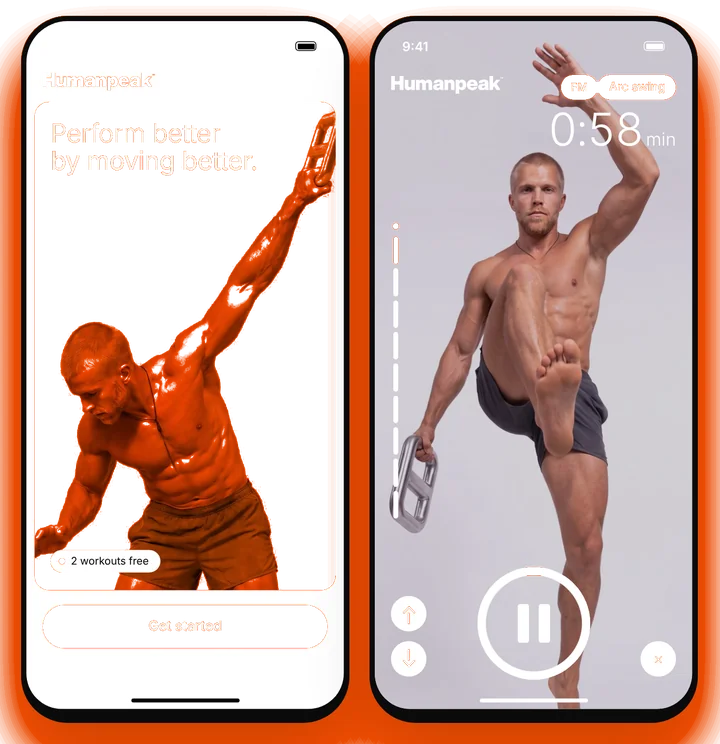
Why the sling decides how much power arrives
Throwing, striking and sprinting all follow the same order. The plant leg accepts the ground, the pelvis turns, the trunk follows and the opposite arm arrives last and fastest. Research on the kinetic chain describes how force generated in the legs and trunk is passed segment by segment to the hand, with the trunk as the link that decides how much of it arrives [6].
The posterior sling is that link, seen from behind. When the hip can extend and the opposite shoulder can reach back, force crosses cleanly. When one end is stiff or untrained, the hand-off suffers and the load goes somewhere else, usually to a shoulder or a lower back that now has to do work that should have been delivered to it.
You've built strength. Now make it transfer. The same idea runs through how to gain power without adding muscle.
How to train the posterior oblique sling
Five principles carry most of the effect:
- Load one side at a time. Split stance, staggered stance, single leg. When both feet do the same thing, the diagonal stays quiet.
- Give the opposite arm a job. Pull, reach or drive the arm back while the standing hip extends. That loads both ends of the sling at once.
- Let the trunk rotate. Rotation is the sign that the diagonal is working. Don't brace it away. Control it.
- Move light and fast. Force is mass times acceleration. A light implement accelerated hard trains how fast force crosses your body, not only how much one muscle can lift.
- Range first, then speed. The pattern needs a hip that can extend and a shoulder that can reach behind you. Build that range under control, then add speed.
Heavy glute work still has its place. It builds the force. The sling decides how much of it arrives.
How Humanpeak trains the diagonal
The 12-Week Movement Protocol is built around fascial lines and loads this diagonal in nearly every session. It runs 5 workouts per week, about 20 minutes each, in three phases. Restore brings back the hip extension and shoulder range the sling depends on. Build loads it. Perform makes it fast.
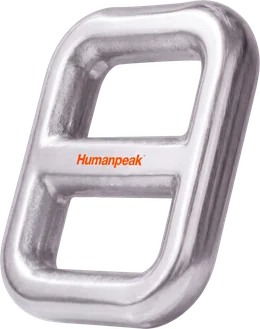
You train with the Humanpeak™ Movement Tool (2.2 kg). Its mass sits off-center, so when you swing it from one hip toward the opposite shoulder, the load keeps changing direction and the whole diagonal has to organize against it. Every flow combines mobility, control and targeted fascial loading through multidirectional movement to train your body as one connected system.
It doesn't replace your glute training. It connects it to the rest of you.
The principles behind Humanpeak are established training science. Studies on the specific tool are still to come.
For the sheet at the center of this diagonal, read about the thoracolumbar fascia. For the front half of the system, read about the anterior oblique sling.
Frequently asked questions
Humanpeak follows clear sourcing guidelines: we rely on peer-reviewed studies, scientific institutions and professional bodies, and aim for primary sources. Spotted an error? Write to us.
This article is for educational purposes only and does not replace medical advice. If you have symptoms, talk to a doctor.

Related articles


