The Anterior Oblique Sling: Where Rotational Power Crosses Your Body


Sport is multidirectional. Most training isn't.
Watch a quarterback release the ball, a tennis player hit a cross-court forehand or a winger cut inside and shoot. The plant foot grips the ground, the pelvis turns, the trunk follows and the opposite arm finishes. Across the front of the body, a band of tissue tightens at the exact moment force has to change sides.
Most athletes learn to protect themselves from rotation. Brace the core, keep the trunk square, don't twist under load. The athletes who rotate best train it the other way. They load rotation, control it and repeat it until the turn is strong in every position.
The anterior oblique sling is a diagonal line across the front of the body: the external oblique on one side, the abdominal fascia at the midline, and the internal oblique and adductors of the opposite side. It helps organize rotation and the braking of rotation between your trunk and the opposite hip. You train it by loading one leg while the opposite shoulder crosses your body, in every direction your sport asks for.
What is the anterior oblique sling?
Turn your trunk to the left and your right shoulder travels forward, while your left hip receives the turn and holds it. The tissue between those two ends is the anterior oblique sling. It runs from the external oblique on one side, through the sheet of abdominal fascia at the center, into the internal oblique and the adductors of the opposite leg.
A sling is not a single muscle. It describes how several structures work as one unit during a task. The obliques drive and steer the turn. The adductors on the other side anchor the pelvis, so the trunk has something to turn against. The abdominal fascia in between is where the force crosses over.
It has a partner on the back of your body. The posterior oblique sling links your glute to the opposite lat, and together the two diagonals form an X across your trunk. Read more about the posterior oblique sling.
A pattern, not a rope
The anatomy is well documented. A systematic review of 62 dissection studies rated the front diagonal among the best-supported lines in the body, with both of its transitions confirmed [1].
What that continuity does in a moving body is more subtle. When researchers pulled on one end of the front line and measured the other, the transfer was slight [2]. So the anterior oblique sling doesn't work like a rope where one end drags the other. It works as a coordination pattern. The obliques and the opposite adductors fire in a specific relationship and a specific order, and the continuous tissue between them makes that relationship efficient.
That is the useful way to think about it for training. You don't strengthen a rope. You train a pattern, and patterns are learned through repetition, variation and load. For the bigger picture of how the lines connect, read myofascial chains explained.
Power starts at the pelvis
Rotational power is a timing problem before it is a strength problem. A meta-analysis of fourteen studies on throwing in team handball found the same order every time. The pelvis turns first, then the trunk rotates, then the trunk flexes, then the shoulder and the elbow follow [3]. Three different throwing techniques, one sequence.
The front diagonal holds that sequence together. The pelvis turns, the abdominal wall on the opposite side tightens so the trunk can whip against it, and the force travels outward to the hand. When the order breaks, the arm starts doing work that should have been delivered to it.
That is why rotational athletes rarely lose power at the shoulder first. They lose it in the hand-off.
Strength doesn't automatically turn
In one 12-week study, two groups of baseball players followed the same strength program and the same batting practice. One group also added rotational and full-body medicine ball work. Both groups gained the same in squat and bench press. The group that trained rotation improved torso rotational strength by 17 to 18 percent instead of about 10, and their hip-to-torso-to-arm throw by 10.6 percent instead of 3.0 [4].
Same base strength. Different rotational output.
There is a second reason the diagonal matters. Force doesn't only run from a muscle into its own tendon. In animal studies, the force at the two ends of the same muscle differed by up to about 23 percent, with the difference leaving through the surrounding connective tissue [5]. Roughly a fifth of your force is transmitted through connective tissue rather than the tendon, yet most training never loads that layer in the directions your sport does.
You've built strength. Now make it transfer.
Fascia makes up about a fifth of you. Our protocol trains it in every direction: 20 minutes, 5 times a week.
Start the protocol 14-day money-back guarantee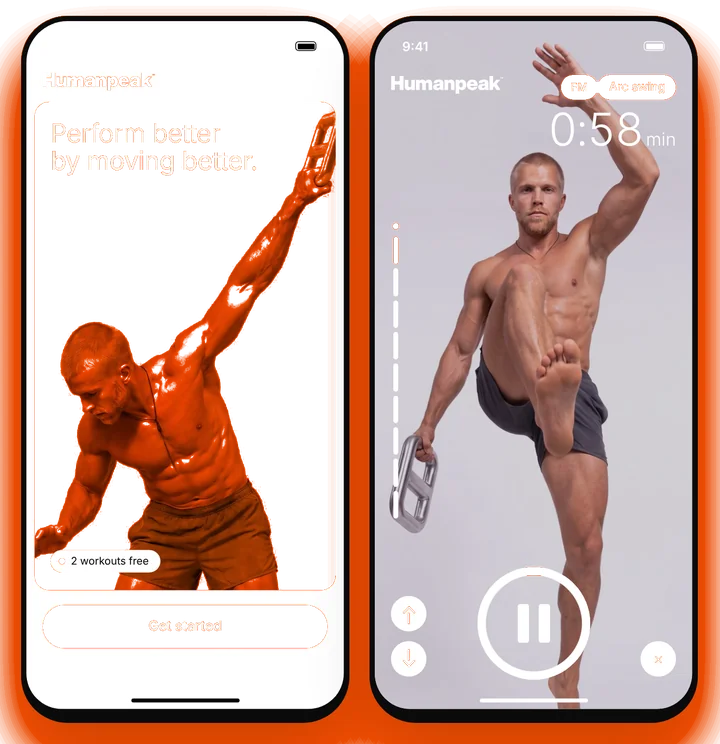
The brake matters as much as the turn
Rotation has a second half that gets less attention: stopping it. Every cut brakes a turning body over one planted leg, and every follow-through slows down a trunk that is still rotating. The adductors are the lower anchor of the front diagonal, and they do two jobs at once. They hold the pelvis, and they brake the leg.
Capacity in that anchor is worth building on its own. In a trial with 652 football players, teams that added a single adductor exercise reported groin problems with 41 percent lower odds than teams that trained as usual [6]. No exercise can promise that outcome for one athlete. It shows that a strong lower anchor is part of a capable rotational system.
Every fast turn needs an equally fast stop. Train both.
How to train the anterior oblique sling
Five principles carry most of the effect:
- Load one leg. Split, staggered and single-leg stances put the pelvis where the sling works. Symmetrical stances let the pattern hide.
- Give the opposite arm a job. Reach, swing, chop or throw across the body, so the diagonal has both of its ends.
- Train the brake, then the turn. Control the rotation first, then let it happen fast. Slowing down is half the skill.
- Use speed instead of heavy load. Force is mass times acceleration. A light implement moved fast and stopped sharply puts real force through the diagonal without grinding heavy rotational load through the spine.
- Vary it. Your sport never asks for the same rep twice. Your training does. Change angle, stance and tempo so the pattern learns to adapt instead of repeat. More on that in why your sport never asks for the same rep twice.
How Humanpeak trains the front diagonal
The 12-Week Movement Protocol is built around fascial lines, and a large share of it is rotation under light load from split and staggered stances. It runs 5 workouts per week, about 20 minutes each, in three phases. Restore brings back the hip and trunk range the pattern needs. Build loads it. Perform makes it fast.
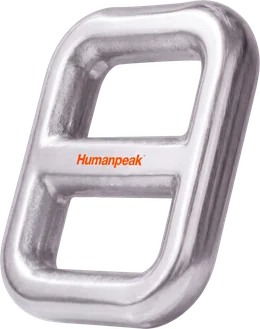
You train with the Humanpeak™ Movement Tool (2.2 kg). Its mass sits off-center from your grip, so the load keeps pulling in a changing direction. Every turn has to be driven by the planted hip and stopped by the opposite side of the trunk. Every flow combines mobility, control and targeted fascial loading through multidirectional movement to train your body as one connected system.
It doesn't replace your strength training. It adds the layer that turns that strength into rotation.
The principles behind Humanpeak are established training science. Studies on the specific tool are still to come.
Frequently asked questions
Humanpeak follows clear sourcing guidelines: we rely on peer-reviewed studies, scientific institutions and professional bodies, and aim for primary sources. Spotted an error? Write to us.
This article is for educational purposes only and does not replace medical advice. If you have symptoms, talk to a doctor.

Related articles


