Myofascial Chains Explained: The Hidden Lines That Carry Your Force


You can see a muscle. You can't see the line it belongs to.
Every throw, swing, cut and sprint stride is built the same way. Force starts at the ground, travels through the hip, crosses the trunk on a diagonal and arrives at the hand or the foot. No single muscle does that. A chain does.
Most training is organized around the muscles you can see in the mirror: chest, back, legs, core. Underneath them sits a second map, long lines of connective tissue that link those muscles into one system. That map decides a large part of how your force travels. And most programs never train it on purpose.
Myofascial chains are continuous lines in which the connective tissue of one muscle blends into the next, so tension travels across joints instead of stopping at the end of a muscle. Dissection research confirms several of these lines, and studies in living people show that loading one end changes what happens further along. For athletes, they are the routes that turn strength in single muscles into force in whole movements.
What are myofascial chains?
Fascia wraps every muscle fiber, every bundle of fibers and every muscle. At the ends, it doesn't simply stop. It blends into the tendon, into the next sheet of tissue and into the neighboring muscle. Follow that continuity far enough and you get long lines that run through the whole body.
Researchers have mapped several of them. One runs up the back of the body, from the sole of the foot through the calves, the hamstrings and along the spine. Two cross the trunk on diagonals. One runs across the back, from the lat on one side to the glute on the other. The other runs across the front, from the obliques on one side to the adductors of the opposite leg.
Those diagonals are the ones athletes use most. They are the shape of a throw, a tennis serve, a golf swing, a crossing punch and a cut off the outside foot. One side drives, the opposite side finishes, and the trunk connects them.
Which lines does research confirm?
The anatomy has been tested on the dissection table. A systematic review screened more than a century of dissection research and included 62 studies to check six of the proposed lines, transition by transition [1].
Three lines came out with strong evidence at every transition examined: the line up the back of the body, the diagonal across the back and the diagonal across the front [1]. Two more were confirmed in parts. One line that runs straight up the front of the body could not be confirmed in the included studies [1].
For athletes, that is good news. The lines that matter most for rotation and sprinting are the ones with the strongest anatomical support. The reviewers also concluded that most skeletal muscles are directly linked by connective tissue [1]. Your body is not a collection of parts that happen to sit next to each other. It is one continuous structure.
Force travels along the line
Continuity is the first half. The second half is whether tension actually moves along it in a living body, and researchers have tested that too.
A second systematic review gathered the studies that loaded one end of a chain and measured the other. It found moderate evidence for force transfer along the line up the back of the body and along the back diagonal [2]. For the front diagonal, the transfer measured so far is slight, which is why it is best described as a coordination pattern your body uses when it rotates.
One experiment makes the back diagonal visible. In 37 people, researchers tensioned the latissimus dorsi, the large back muscle that pulls your arm down and back, and measured the opposite hip. When the lat contracted, the resting position of that hip shifted and its stiffness rose [3]. One shoulder, the opposite hip, and a measurable link across the lower back.
The effects are modest, and they were measured in the lab, not in a sprint. But they describe what every athlete feels: pull on one part of the system, and the rest of it answers.
Your body is a connected system that stores, transfers and expresses force.
The missing fifth
Here is why chains matter for performance and not only for anatomy.
Force does not only travel from a muscle straight into its own tendon. Part of it leaves sideways, into the surrounding connective tissue and on to neighboring muscles. In animal studies with the fascia left intact, the force measured at the two ends of the same muscle differed by up to about 23 percent. The connective tissue carried the difference away [4].
Roughly a fifth of your force is transmitted through connective tissue rather than the tendon. That share runs through the same tissue that forms your chains. It is part of how a push into the ground ends up in a throw.
Strength training builds how much force you can produce. But athletic performance depends on how effectively that force travels through your body and into the ground. Most training never loads that layer deliberately, and that is the missing link between being strong and being able to use that strength in motion.
Fascia makes up about a fifth of you. Our protocol trains it in every direction: 20 minutes, 5 times a week.
Start the protocol 14-day money-back guarantee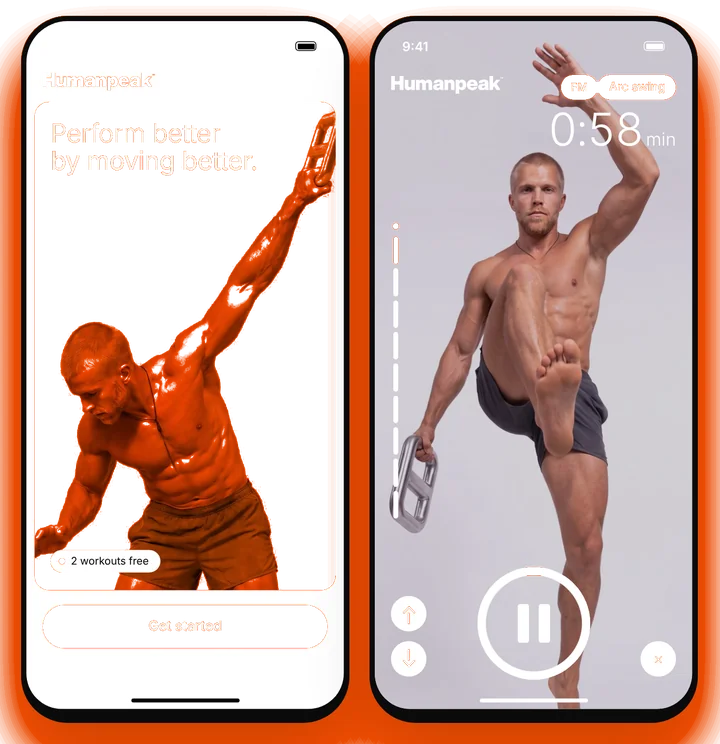
Why isolated training misses the chain
Look at a typical program. Most exercises work one muscle group, on two feet, in a straight line: up and down, forward and back. That builds strong links. It doesn't train how the links connect.
Sport works the other way around. One foot is planted, the trunk turns, the opposite arm reaches, and all of it happens at speed and from a new angle every time. The chain has to organize the force in all of those directions at once.
Isolated movement trains a muscle. Interconnected movement trains the chain.
That doesn't make isolated strength work wrong. It is the base. The point is that strength in single muscles doesn't automatically become force in whole movements. That transfer is a quality of its own, so it needs its own training.
How to train your myofascial chains
Five principles carry most of the effect:
- Cross the body. Connect one shoulder to the opposite hip in a single movement. Swings, reaches, throws and pulls that cross the midline load the diagonals your sport uses.
- Load one leg. Split, staggered and single-leg stances put the pelvis in the position where the chains work. Two feet side by side let the pattern hide.
- Rotate, then brake. Let the trunk turn, then control the stop. The diagonals are built for rotation and for slowing it down.
- Add speed and variation. Once a position is controlled, move faster and change angle, tempo and range. Your sport never repeats the exact same rep, so your chains shouldn't learn only one.
- Stay regular and progressive. Coordination improves within weeks. Connective tissue adapts to load over months [5]. Short, frequent sessions with a clear progression build both.
For the two diagonals in detail, read about the posterior oblique sling and the anterior oblique sling.
How Humanpeak trains your chains
Humanpeak is built around fascial lines. The 12-Week Movement Protocol runs 5 workouts per week, about 20 minutes each, in three phases: Restore, Build, Perform. Restore brings back usable range and control. Build loads that range. Perform connects the whole body through integrated movement, rotation and speed.
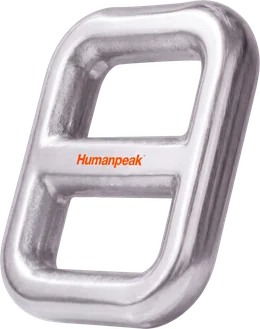
You train with the Humanpeak™ Movement Tool (2.2 kg). Its mass sits off-center, so the load keeps pulling in a changing direction and the whole chain has to organize against it in every rep. Every flow combines mobility, control and targeted fascial loading through multidirectional movement to train your body as one connected system.
It doesn't replace your training. It adds the layer your training leaves out: the connection between the parts.
The principles behind Humanpeak are established training science. Studies on the specific tool are still to come.
Frequently asked questions
Humanpeak follows clear sourcing guidelines: we rely on peer-reviewed studies, scientific institutions and professional bodies, and aim for primary sources. Spotted an error? Write to us.
This article is for educational purposes only and does not replace medical advice. If you have symptoms, talk to a doctor.

Related articles


