What Is Fascia? The Tissue Anatomy Cut Away Carries Your Force


Not all strength becomes performance.
For a long time, fascia was the part of the body you cut away. Anatomy students cleared it off to get a clean view of the muscles underneath. The muscles got the names, the textbook chapters and, later, the training plans. The tissue that wrapped and linked them was treated as filler.
Training still works that way. Chest day, leg day, one muscle at a time. And plenty of athletes feel the result: strong in the gym, and still something missing when they sprint, cut, throw or land. The force is there. It just doesn't arrive where the movement needs it.
Part of the answer sits in the tissue that was cut away.
Fascia is the connective tissue network that wraps, links and holds together your muscles, tendons and joints in one continuous system. It transfers part of your force between muscles, works with your tendons as a spring and is wired with nerve endings. It adapts to the way you load it, which means it can be trained.
What is fascia?
Fascia is connective tissue: collagen fibers for strength, elastic fibers for give and a water-rich gel in between. It forms a sleeve around every muscle fiber, around every bundle of fibers and around every whole muscle. It continues into tendons, ligaments and joint capsules, and it forms the sheets that connect one muscle group to the next.
There is no clean edge where one piece stops and the next begins. That is the most important fact about it. A consensus statement from sports medicine researchers describes the fascial system as a three-dimensional network that runs through the entire body and lets its systems work together [1]. Not a collection of separate wrappers. One system.
It is also large. A common estimate puts it at around a fifth of your body weight. Where that number comes from, and why it is an estimate, is in how much of you is fascia.
One system, not separate parts
Your training plan splits the body into parts. Your sport never does. A throw starts at the ground, travels through the hip and the trunk and leaves through the hand. A cut loads one foot, the opposite hip and the trunk in the same moment.
Fascia is built for that. When researchers checked the popular maps of myofascial lines against dissection studies, three lines held up with strong evidence: one along the back of the body and two that run diagonally, from the shoulder across the trunk to the opposite hip [4]. Those diagonals are the anatomy of rotation. Every swing, throw and change of direction runs through them.
Some researchers describe the whole body as a tension network, a model called tensegrity. Bones act as spacers, connective tissue as the cables that keep the structure under tension. It is a model, not a measurement. But it matches what athletes feel: pull on one part, and the whole system answers.
Your body is a connected system that stores, transfers and expresses force.
Fascia moves your force
This is where fascia matters for performance. The textbook says a muscle pulls on its tendon and the tendon moves the bone. That is true. It just isn't the whole story.
In animal studies with the surrounding tissue left intact, the force measured at the two ends of the same muscle differed by up to about 23 percent [2]. Part of the force left sideways, through connective tissue, into neighboring muscles and along the chain. The consensus statement lists fascia as a pathway for force alongside the tendon [1].
Roughly a fifth of your force is transmitted through connective tissue rather than the tendon, yet most training doesn't load that layer deliberately. Strength training builds how much force you can produce. Athletic performance depends on how effectively that force travels through your body and into the ground. That is the missing link between being strong and being able to use that strength in motion.
Fascia is your spring
Watch a sprinter at top speed. The foot touches the ground and leaves it almost in the same moment. That rebound is the elastic system at work.
When researchers watched the calf with ultrasound during a countermovement, the quick dip before you push off, the muscle fibers barely changed length. The tendon stretched on the way down and recoiled on the way up, storing energy and giving it back [3]. The muscle held the position. The connective tissue did the bouncing.
Tendons and fascia are the elastic part of your body. When that spring works, movement feels light. When it doesn't, your muscles have to do more of the work on their own. Athletes know the feeling: every step costs effort, the same muscles tire first, nothing comes back for free. Muscle alone is only half the system. More on the spring in elastic recoil training.
Fascia makes up about a fifth of you. Our protocol trains it in every direction: 20 minutes, 5 times a week.
Start the protocol 14-day money-back guarantee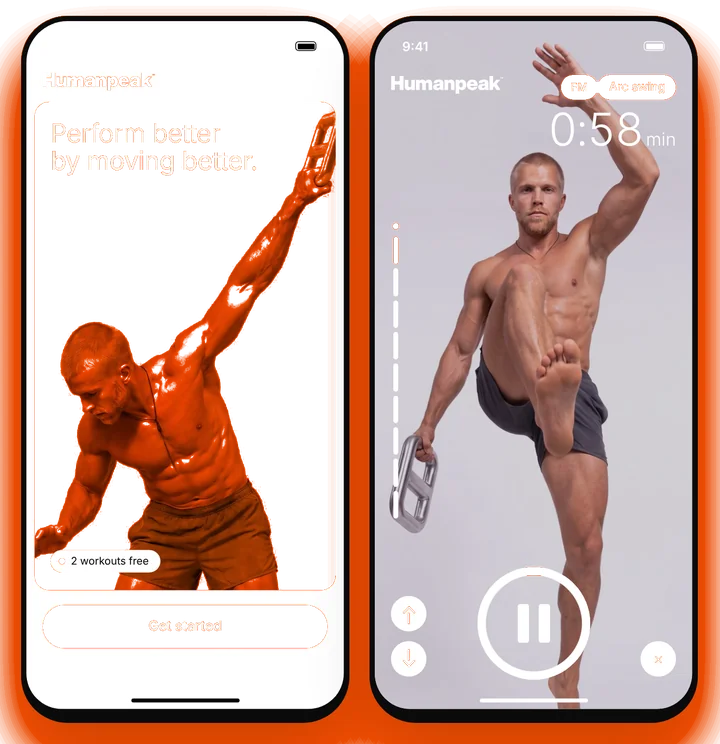
Fascia feels, and it glides
Fascia is living tissue. A review of 23 studies found it well supplied with nerve endings, especially the kind that report position and pain [5]. It is one of the inputs your nervous system reads every time you move. So varied movement gives your body more to work with than the same rep repeated: every new angle is new information about where force should go.
Fascia also has to slide. Between its layers and the muscles underneath sits a thin layer rich in hyaluronan, a molecule that binds water, produced by cells researchers named fasciacytes [6]. That layer lets neighboring tissues glide over each other when you rotate, reach or decelerate. Moving it keeps it working, which is what we mean when we talk about rehydrating your fascia. The full picture is in fascia hydration.
Why most training leaves fascia out
Sport is multidirectional. Most training isn't.
Athletic movement happens through rotation, diagonal patterns, acceleration and changes of direction. Most strength training stays slow, isolated and largely sagittal: up and down, forward and back. It does a great job of building force. It barely loads the diagonals, rarely asks for fast reversals and almost never makes the chain organize against a load that changes direction mid-movement.
Connective tissue adapts to the load it gets, over weeks and months [1]. Give it one direction and it learns one direction.
Rolling and massage have their place. They can make tissue feel looser and calmer for a while, and that relief is real. But they work from the outside. Rolling changes how fascia feels. Loading it in new directions changes how your body uses it.
How to train your fascia
Five principles carry most of the effect:
- Every direction. Rotation, diagonals, lateral steps and changes of direction, because that is how your sport loads you.
- The whole chain. From the foot through the hip to the opposite shoulder, instead of one muscle at a time.
- Elastic. Rhythm, rebound and quick reversals, so the spring learns to store and return energy.
- Variation. Repetition builds patterns. Variation builds adaptability. Change angle, tempo and range.
- Regular and progressive. Connective tissue adapts over weeks and months, not days [1]. Short, frequent sessions with a clear progression beat the occasional long one.
How Humanpeak trains the missing layer
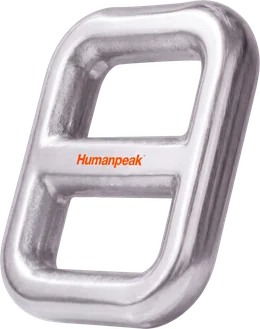
Humanpeak is built around fascial lines. The 12-Week Movement Protocol runs 5 workouts per week, about 20 minutes each, in three phases: Restore, Build, Perform. You train with the Humanpeak™ Movement Tool (2.2 kg). Every flow combines mobility, control and targeted fascial loading through multidirectional movement, so your body trains as one connected system again.
It doesn't replace your training. It sits on top of it and adds the layer your training leaves out. You've built strength. Now make it transfer.
The principles behind Humanpeak are established training science. Studies on the specific tool are still to come.
Frequently asked questions
Humanpeak follows clear sourcing guidelines: we rely on peer-reviewed studies, scientific institutions and professional bodies, and aim for primary sources. Spotted an error? Write to us.
This article is for educational purposes only and does not replace medical advice. If you have symptoms, talk to a doctor.

Related articles


