Elastic Recoil Training: Your Body Is a Spring. Most Training Never Loads It.


Absorb, redirect and return force faster.
Watch a great point guard cut, a sprinter hit top speed or a pitcher release the ball. It looks light. Almost effortless. That isn't only muscle. It's energy that was stored a fraction of a second earlier and given back at exactly the right moment.
Your body has a spring built into it: tendons, fascia and the connective tissue that wraps and links every muscle. When that spring works, you hit the ground and come off it fast. When it doesn't, your muscles have to do the job alone, and every step, jump and turn feels like work. Most training builds the muscle. Very little of it trains the spring.
Elastic recoil is your connective tissue storing energy when it is stretched and returning it when the load drops. Tendons are the best-measured part of that spring, and fascia is part of the same elastic network. Elastic recoil training loads and releases that system in rhythm, so force arrives faster and every movement costs less.
Your body is built like a spring
Every time you land, plant or wind up, your connective tissue gets stretched. Springy tissues store elastic energy as force is applied and recoil to release it as force decays [1]. Nothing comes from nowhere. A spring returns what you load into it.
So where is the advantage? In the timing. Muscle can load the spring over a slower phase, and the spring can release that energy much faster than the muscle could on its own [1]. Load slow, release fast. That is how a short, sharp movement can carry more power than the muscle alone would deliver. In animals the effect is extreme: a jumping guinea fowl produces more than twice the peak power its leg muscles could [1]. Humans are less dramatic, but the design is the same.
The spring has a second job, and that is economy. In cyclic movement like running, part of every stride is paid for by recoil instead of fresh contraction, so elastic tissue saves metabolic energy [1]. A spring that gives back more costs you less, step after step.
The muscle holds. The connective tissue bounces.
This is the part that changes how you think about training. When researchers watched the calf with ultrasound during a countermovement, the quick dip before you push off, the muscle fibers worked at almost the same length the whole time. The tendon did the stretching and the recoiling. It stored energy on the way down and returned it on the way up [2].
The muscle's job in that moment was to hold the position and set the tension. The connective tissue did the bouncing.
That is why two athletes with the same strength can move completely differently. One loads the spring and leaves the ground fast. The other absorbs the landing, pauses and pushes again from scratch. Same engine. Different spring.
Your body is a connected system that stores, transfers and expresses force. The muscle produces it. The connective tissue stores it, carries it and gives it back.
Where the spring lives
The tendon is the most measured spring in your body, because it sits in line with the muscle and can be tracked directly in a living athlete. But it doesn't work alone. Tendons merge into fascia, fascia wraps every muscle, and sheets of fascia link one muscle group to the next. Together they form one elastic network.
Fascia is part of that spring. A model of the iliotibial band, the thick reinforcement of the fascia on the outside of your thigh, estimates that it stores around 7 joules of elastic energy per stride at a fast run of 5 meters per second [3]. It is one structure at one speed, and a model rather than a direct measurement. Still, it shows a fascial sheet doing spring work, right where your hip drives your stride.
And the network does more than bounce. It also carries force from one muscle to the next. Roughly a fifth of your force is transmitted through connective tissue rather than the tendon, yet most training doesn't load that layer deliberately. More on that in how much of you is fascia.
Why your sport runs on the spring
Your sport doesn't give you time. At top sprinting speed, each foot is on the ground for about 0.1 seconds. The same athletes produced clearly more force when hopping in place, where contact lasts longer. So the limit at top speed was not how much force they had. It was how much they could apply in the time available [4].
A tenth of a second is far too short for a muscle to build force from zero. That window belongs to the spring: tissue that is already under tension meets the ground, stretches and returns.
Sprinting is only one example. A cut is a spring loaded sideways. A throw is a spring loaded through the hips, trunk and shoulder, then released into the arm. A landing that turns straight into the next jump, a swing that coils and uncoils. Your sport is a chain of loading and returning, in every direction.
Not all strength becomes performance. Strength training builds how much force you can produce. But athletic performance depends on how effectively that force travels through your body and into the ground, and how fast it gets there.
Fascia makes up about a fifth of you. Our protocol trains it in every direction: 20 minutes, 5 times a week.
Start the protocol 14-day money-back guarantee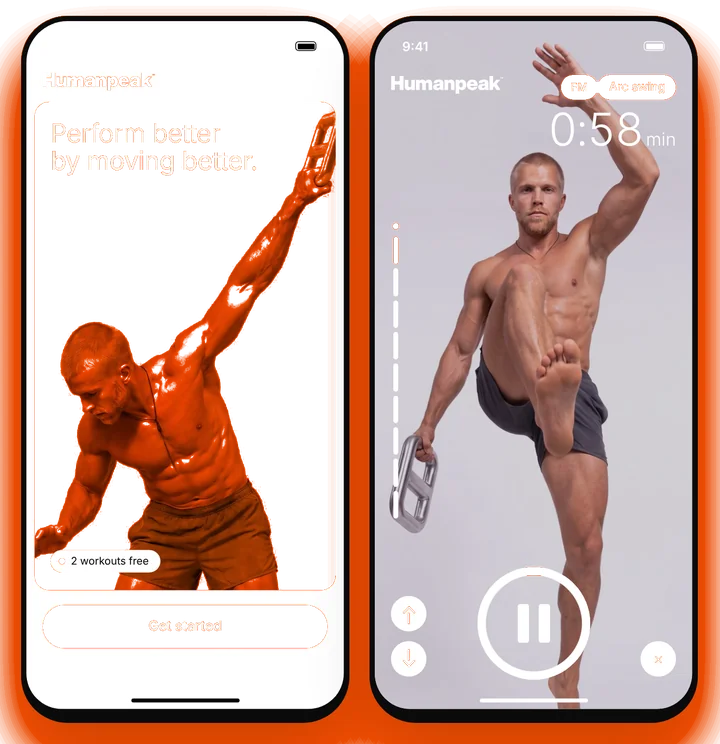
Strength builds the spring. Elastic training teaches you to use it.
The spring is trainable, and the research points to two layers.
The first is how you use the spring: how fast you load it, how cleanly you reverse, how much of the stored energy reaches the next movement. That responds to repeated elastic work. A meta-analysis of 70 randomized trials in athletically trained adults found that plyometric training improved jumping, reactive strength and sprint times over 10 to 30 meters [5]. Those are numbers for jump training, not for Humanpeak. But they show that the reactive side of the spring keeps improving, even in athletes who already train hard.
The second is the tissue itself. Tendons get stiffer with training, and what decides it is how heavy the load is, not the type of contraction [6]. Heavy, progressive lifting builds a spring that can hold more force. That is a good reason to keep lifting.
Put both together and the picture is clear. Heavy load builds the spring. Fast, elastic loading teaches your body to use it. You've built strength. Now make it transfer.
How to train elastic recoil
You don't need depth jumps to start. Five principles carry most of the effect:
- Short contact, quick reversal. The energy lives in the transition. A long, soft pause between loading and returning spends the energy instead of giving it back. Keep the turn from down to up, or from back to forward, quick and clean.
- Start small, then build. Small hops, ankle rebounds, skips and light swings load the spring at amplitudes your tissue handles well. Range, speed and complexity come later.
- Every direction. Most training moves up and down, forward and back. Your sport loads the spring sideways and in rotation too. Diagonals, lateral steps and turns train the chain from the foot through the hip to the opposite shoulder.
- Quality over fatigue. Elastic work is timing, and timing falls apart when you're tired. Short sets, full intent, enough rest. Tired reps teach the wrong rhythm.
- Regular and progressive. Reactive qualities respond within weeks, connective tissue adapts over months [5][6]. Short, frequent sessions with a clear progression beat the occasional long one.
For the ankle side of the spring, read ankle stiffness and the Achilles spring.
How Humanpeak trains the spring
The 12-Week Movement Protocol runs 5 workouts per week, about 20 minutes each, in three phases. Restore brings back usable range and control. Build adds load and multidirectional control. Perform turns that capacity into speed, elasticity and efficient force transfer. Every flow combines mobility, control and targeted fascial loading through multidirectional movement.
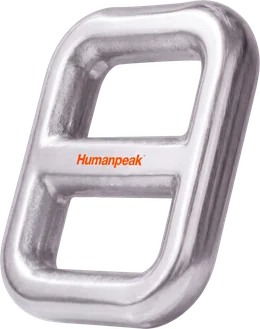
You train with the Humanpeak™ Movement Tool (2.2 kg). Most of its mass sits outside your grip. When you accelerate it, the offset mass keeps pulling and its pull changes direction through the movement, so every rep ends in a stop and a reversal: absorb the momentum, redirect it, return it. Light enough to move fast, heavy enough that every reversal loads the spring. And because the pull arrives from a slightly different angle each time, your spring learns to work in every direction, not only one.
It doesn't replace your strength training. It adds the layer your strength training leaves out. Your lifting builds the spring. Humanpeak trains how you use it.
The principles behind Humanpeak are established training science. Studies on the specific tool are still to come.
Frequently asked questions
Humanpeak follows clear sourcing guidelines: we rely on peer-reviewed studies, scientific institutions and professional bodies, and aim for primary sources. Spotted an error? Write to us.
This article is for educational purposes only and does not replace medical advice. If you have symptoms, talk to a doctor.

Related articles


