Why Fast Athletes Have Stiff Ankles: The Achilles Spring, Explained


Watch a sprinter at top speed and the foot barely seems to touch the track. It lands, it is gone. Watch a good jumper and the takeoff looks less like a push and more like a bounce. Coaches have a word for what they are seeing: stiffness. Fast athletes have stiff ankles.
A popular line on social media turns this into a rule: stiff ankles and a springy Achilles are the secret of every sprinter and jumper. The line is half right, and the half that is wrong is the half that decides how you train. "Stiff" means two opposite things in sport, the spring is not set where most athletes think, and the tissue that stores the energy and the system that uses it adapt to different kinds of training.
Here is what the research says about the Achilles spring, where speed is actually tuned, and why building the spring and learning to use it are two separate jobs.
Fast athletes have stiff ankles in the dynamic sense: at ground contact the ankle resists collapsing, so the Achilles tendon stretches, stores energy and returns it in a fraction of a second. That joint stiffness is an active, trained behavior, not a lack of range, and restricted ankle mobility is a separate problem. The tendon itself gets stiffer only under heavy loading, while fast, elastic training improves how well the leg uses the spring. Athletes need both.
What does "stiff ankle" actually mean?
The confusion starts with the word. In sport science, joint stiffness is a measurement: how much the joint moment rises for each degree the joint bends under load [3]. A stiff ankle, in this sense, is one that holds its shape when the ground pushes back. It is active. It depends on muscle activation, timing and the tendon in series with the muscle. It changes from task to task, and from step to step.
In the training room, "stiff ankle" usually means the opposite of something good: an ankle that cannot dorsiflex, the shin that cannot travel forward over the foot in a squat, a lunge or a deceleration step. That is a range problem, not a spring.
The two are not just different. They can pull in opposite directions. Backman and Danielson followed 75 elite basketball players for a year. Players whose ankle dorsiflexion range measured under 36.5 degrees had an 18.5 to 29.4% risk of developing patellar tendon problems within the year, compared with 1.8 to 2.1% for players above that range [10]. The authors' explanation: when the ankle cannot take its share of the landing, the knee takes more. It is one cohort with a small number of cases, so it is a warning, not a cutoff to chase. But it makes the distinction concrete. The athlete you want to be has an ankle that moves freely through its range and then holds firm at contact. Mobile first, then stiff when it counts.
How does the Achilles work as a spring?
When your foot hits the ground in a hop, a sprint or a cut, your body is still moving down and forward. The calf muscles contract, but they do not have time to shorten and lengthen much. Instead, the tendon in series with them takes the stretch. It lengthens under load, stores that work as elastic energy and gives it back as the ankle pushes off.
Lichtwark and Wilson measured this directly in ten men hopping on one leg, combining ultrasound of the muscle-tendon junction with force data. Average peak tendon strain was 8.3%. The tendon returned an average of 38 J of energy per hop through elastic recoil, which contributed 16% of the total mechanical work of the hop [1]. Two details matter. First, the tendon is not a perfect spring: across participants, between 17 and 35% of the stored energy was lost as heat (the inter-quartile range for hysteresis). Second, stiffness varied widely between individuals, so the energy each tendon could store varied too [1].
Time is why this matters. Weyand and colleagues tested seven athletic subjects at top speed. In forward running, foot-ground contact lasted about 0.11 seconds. In one-legged hopping, the same athletes pushed into the ground with more than half a body weight more force, but needed about 0.16 seconds to do it [4]. The authors concluded that top speed is limited not by how much force the legs can apply, but by the minimum time needed to apply it. In a window of about a tenth of a second, there is no time to build force slowly. A spring that is already loaded when the foot lands is how the body beats that clock.
A note on terms, because the word fascia comes up in this conversation. Humanpeak talks about the fascial system or elastic system as the whole connective network: fascia, tendons, ligaments and the connective tissue inside muscle. The hardest spring numbers in this article are tendon numbers. The Achilles is the most studied spring in that system, not the only one. For the full picture of where elastic energy is stored, see elastic recoil training.
Is the ankle really where speed is set?
Partly. And the part that is wrong is the interesting part.
For bouncing in place, the ankle is the main dial. Farley and Morgenroth had five subjects hop at a fixed frequency, once at a comfortable height and once as high as possible. Leg stiffness roughly doubled in maximal hopping. Ankle stiffness rose 1.9-fold, knee stiffness 1.7-fold. They then ran a computer model of the leg as a chain of torsional springs. Raising ankle stiffness by 1.9-fold raised leg stiffness by 2.0-fold. Raising knee stiffness by 1.7-fold had virtually no effect [2]. Their conclusion: during hopping, leg stiffness is adjusted primarily through the ankle.
Sprinting tells a different story. Kuitunen, Komi and Kyröläinen had ten male sprinters run over a force platform at 70, 80, 90 and 100% of their top speed. Average ankle joint stiffness stayed constant across all speeds, at about 7 Nm per degree. Knee joint stiffness rose from 17 to 24 Nm per degree as the sprinters went faster [3]. The authors suggested the constant ankle value may reflect the fixed stiffness of the Achilles tendon, which dominates the calf muscle-tendon unit. To get faster, the sprinters tuned the leg spring at the knee.
So the viral claim gets the foundation right and the adjustment wrong. The ankle and its tendon are the base spring. They have to be there, every step. But at speed, the stiffness of the whole leg is regulated higher up the chain, by how the knee and hip hold their shape at contact. That is a whole-body skill, and it is one reason a strong calf alone does not make a fast athlete.
| WHAT THE CLAIM SAYS | WHAT THE RESEARCH SHOWS |
|---|---|
| Fast athletes have stiff ankles | Accurate in the dynamic sense: the ankle resists collapse at contact so the tendon can store energy [1, 2] |
| A springy Achilles powers sprinting and jumping | The Achilles returned about 16% of the work of a hop through recoil, with large individual differences [1] |
| The ankle sets your speed | In hopping, ankle stiffness drives leg stiffness. In sprinting, ankle stiffness stayed constant and the knee did the adjusting [2, 3] |
| Stiffer is always better | Not consistently. Stiffer tendons were linked to faster force development in one study, more compliant ones to faster sprinters in another [5, 6] |
| Stiff ankles are good, so ankle mobility does not matter | Restricted dorsiflexion was linked to a higher rate of patellar tendon problems in one basketball cohort [10] |
Built around fascial lines. 20 minutes per session, 5 times a week, guided step by step in the app.
Start the protocol 14-day money-back guarantee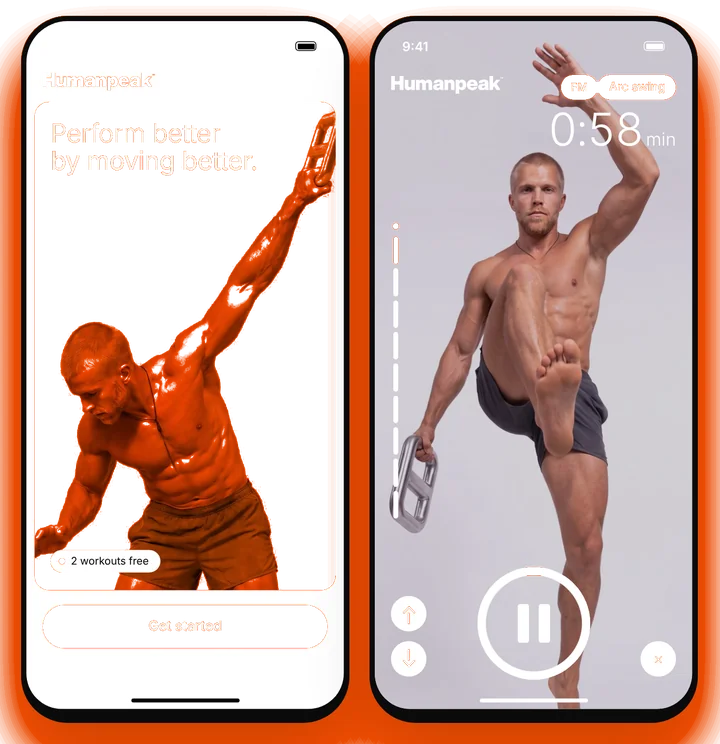
Is a stiffer tendon always a faster tendon?
This is where the evidence gets honest, and more useful.
Bojsen-Møller and colleagues measured the stiffness of the tendon-aponeurosis complex of the vastus lateralis, the big outer thigh muscle, in 16 trained men. Stiffer tendinous structures went with faster rate of torque development (r = 0.55), which the authors estimated could account for up to 30% of the variance. Stiffness also correlated with squat jump and countermovement jump height (r = 0.64 and 0.55) [5]. Their interpretation: a stiffer tendon transmits force from muscle to bone more effectively. Less slack to take up, faster arrival of force.
Stafilidis and Arampatzis compared 17 fast and 11 slower sprinters. Maximal joint moments and muscle architecture did not differ between the groups. But the fast group showed greater elongation of the vastus lateralis tendon and aponeurosis at a given force, a more compliant structure. Maximal elongation correlated with 100 m time (r = -0.567): the more the tendon stretched, the faster the sprinter [6]. At the calf, the groups did not differ. The authors argued that the extra stretch benefits energy storage and return and lets the muscle-tendon unit shorten faster.
Both findings can be true, because they measure different jobs. A rigid connection is good for transmitting force quickly in a single maximal effort. A tendon that stretches a bit more under the large loads of sprinting can store more energy, as long as the muscle can control it. The useful takeaway is not "stiffer" or "softer." It is matched: a tendon whose stiffness fits the forces the athlete produces and the movement the sport demands. Both are cross-sectional correlations in small groups, so neither proves cause. What they do disprove is the idea that more stiffness is automatically more speed.
If you have read our article on hypermobility and stiffness, this is the same principle from the other side: stiffness is a performance quality, not a virtue in itself.
How do you build the spring, and how do you learn to use it?
Here the research is unusually clear, and it splits the job in two.
The tendon responds to heavy load. Bohm, Mersmann and Arampatzis pooled 27 studies with 37 training interventions on the Achilles and patellar tendons. Tendon stiffness increased with training, and the decisive factor was loading intensity, not contraction type [7]. Arampatzis and colleagues showed the threshold within the same people: one leg trained at low tendon strain (about 2.9%), the other at high strain (about 4.6%), same frequency and volume, for 14 weeks. Only the high-strain leg got a stiffer Achilles tendon. The low-strain loading was not a sufficient stimulus beyond what everyday activity already provides [8].
The joint learns to use the spring under fast, elastic loading. Kubo and colleagues trained ten participants for 12 weeks, one leg with plyometric hopping and drop jumps at 40% of maximum, the other with heavy calf raises at 80% of maximum. Heavy training increased tendon stiffness. Plyometric training did not change the tendon at all, but it increased ankle joint stiffness during drop jumps and improved all three jump tests. The plyometric leg's relative jump gains were significantly greater [9]. The spring got stiffer in one leg. The other leg got better at bouncing.
That is the whole story of this article in one experiment. The heavy leg built the spring. The plyometric leg learned to time it.
And a stiffer spring can pay off. Albracht and Arampatzis put 13 participants through 14 weeks of calf-focused resistance training and compared them with 13 controls. Plantar flexor strength rose about 7%, triceps surae tendon-aponeurosis stiffness about 16%, and the energy cost of running fell about 4%. The control group did not change. Running kinematics stayed the same, so the authors suggest the stiffer tendon stored and returned more energy per step [11]. The tendon got stiffer, and the same stride cost less.
What this means for a training week:
- Heavy, slow calf and lower-leg strength work for the tendon. Single-leg calf raises, loaded, controlled, high effort. This is the part no light training replaces [7, 8].
- Plyometrics for the joint: pogo hops, skips, bounds and drop jumps, progressed carefully, so the ankle learns to meet the ground already stiff [9].
- Full ankle range so the spring has room to load: the shin travels over the foot, and the stiffness shows up at contact, not in the joint's resting range [10].
- Multidirectional loading, because the ground in your sport does not push back from one direction only. Cuts, crossovers and decelerations load the ankle at angles a calf raise never does.
- FOCUS: stiff at contact, free through range
- LOAD: heavy and slow for the tendon, light and fast for the joint
- TEMPO: short contacts, fast reversals
How Humanpeak trains this
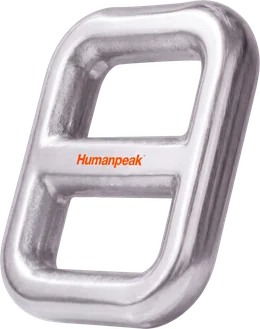
Absorb, redirect and return force faster. That line from the Humanpeak method describes exactly what a good ankle does at contact, and it describes the rhythm of every flow with the Humanpeak™ Movement Tool: accelerate, stop, catch the momentum, return. The tool weighs 2.2 kg, cast in one piece from aluminum, with its mass sitting outside your grip. When you stop it, the offset mass keeps pulling, and the torque changes direction mid-movement. Your stance has to absorb that pull and redirect it through the chain, from hand to trunk to foot, and the pull arrives from a different direction every rep. That is the spring being used: springy, rhythmic movement with fast reversals, under load your body has to organize against.
Here is what the Movement Tool does not do: build a stiffer Achilles tendon. The research is clear that tendon stiffness needs high load [7, 8], and 2.2 kg in your hands is not that. Heavy load builds how much force you can create and builds the spring itself. The Movement Tool trains how fast you can create force, plus elasticity, control, coordination and force transfer: how well your body uses the spring it has, in every direction your sport asks for. The 12-Week Movement Protocol runs this in three phases, Restore, Build and Perform, with 5 workouts per week of about 20 minutes each and over 450 movement flows. Every flow combines mobility, control and targeted fascial loading through multidirectional movement. Keep your heavy calf work and your plyometrics. This is the layer between them and your sport. The principles behind Humanpeak are established training science. Studies on the specific tool are still to come.
Fast athletes do have stiff ankles. They also have mobile ones, tendons matched to their strength, and a leg that knows when to hold and when to let go. Build the spring. Then learn to use it.
Move better. Perform better.
Fact check
Frequently asked questions
Humanpeak follows clear sourcing guidelines: we rely on peer-reviewed studies, scientific institutions and professional bodies, and aim for primary sources. Spotted an error? Write to us.
This article is for educational purposes only and does not replace medical advice. If you have symptoms, talk to a doctor.


