Hypermobile or Stiff? Why Athletes Need Tendon Stiffness, Not Just Range


Two athletes walk into the same gym. One can fold flat in a forward bend, touches thumb to forearm, and has sprained the same knee twice. The other cannot get a palm near the floor, feels tight everywhere, and has never been seriously hurt. Both think the other one has the body they want. Both are wrong about what their body needs.
A reel with millions of views tells the first athlete that joint instability is directly tied to "fascial health." It sounds right. Fascia is connective tissue, hypermobility is a connective tissue trait, and the word "health" implies something you can restore. The research tells a more precise story, and for a hypermobile athlete, a more useful one.
Here is what the science says about hypermobility, about stiffness, and about the one quality both athletes are missing.
Hypermobility is a heritable connective tissue trait measured on the Beighton scale, not a condition of fascial health you can roll or stretch into shape. Hypermobile athletes face a higher knee injury risk in contact sports, show poorer lower-limb position sense, and in one study had less stiff Achilles tendons. What protects a joint is not range but control: tendon stiffness, which rises with heavy loading, and strength and proprioception, which research links to far fewer injuries. The stiff athlete needs the same thing from the other side: range that is built under load and usable at speed.
What does hypermobility actually mean?
The standard measure is the Beighton score, published in 1973 from a survey of joint mobility in a South African population. It checks nine things: can you bend each little finger back past 90 degrees, touch each thumb to your forearm, hyperextend each elbow and each knee, and place your palms flat on the floor with straight legs. One point each, out of nine [1]. A common cutoff for generalized joint hypermobility is four or more, though studies vary.
Most people who score high have no symptoms. They are flexible, often good at gymnastics, dance or swimming, and nothing hurts. Castori and colleagues, in the 2017 framework that organizes this field, describe a spectrum: from asymptomatic hypermobility, through hypermobility with musculoskeletal symptoms, to heritable disorders of connective tissue where joint laxity is one feature among many [2]. The common thread across that spectrum is the tissue itself. Collagen structure, ligament compliance and joint capsule laxity are, for the most part, inherited.
That is the first correction to the reel. Hypermobility is not something your fascia caught. It is the way your connective tissue was built. The question for an athlete is not how to fix it. It is how to train around it.
Why do hypermobile athletes get hurt more?
Pacey and colleagues pooled 18 studies on hypermobility and lower-limb injury in sport. Because the studies used different tests and cutoffs, they set a standardized threshold before analyzing. The result: hypermobile participants had a significantly increased risk of knee joint injury compared with non-hypermobile peers. In contact sports the combined odds ratio was 4.69, with a wide confidence interval from 1.33 to 16.52. Ankle injury risk was not raised [3].
Two things matter in that result. First, it is joint-specific. The knee, a hinge that relies on ligaments for lateral and rotational control, is where laxity costs most. The ankle, which has bone and tendon doing more of the work, did not show the same pattern. Second, the mechanism is contact: collisions and unplanned loads, where a joint has to hold position against a force it did not choose.
Why would laxity raise that risk? The reel says fascial health. The research points somewhere else.
Smith and colleagues reviewed five studies with 254 participants comparing joint position sense in people with and without symptomatic joint hypermobility. The hypermobile group was significantly worse at sensing lower-limb joint position and at detecting the onset of movement [4]. Position sense is the input your nervous system uses to stabilize a joint before and during load. If the input is noisier, the output is slower, and a knee that is already more mobile has less time to catch itself.
A second finding goes to the tissue directly. Rombaut and colleagues measured passive muscle-tendon properties in 25 women with the hypermobility type of Ehlers-Danlos syndrome, a heritable connective tissue disorder, against 25 matched controls. The Achilles tendon was significantly less stiff in the hypermobile group [5]. This is a clinical population and a small sample, so it does not describe every athlete with a high Beighton score. But it shows what "connective tissue trait" means in measurable terms: the tendon stretches more for a given force. That is a spring with a softer coil.
So instability is linked to connective tissue. That much the reel gets right. But "fascial health" implies a state you can improve by treating the fascia: rolling, releasing, hydrating, stretching. None of the research above describes a tissue that responds to that. It describes a tissue that was built a certain way and a control system that has to compensate for it. Fascia is part of the picture. Health is the wrong frame.
Why is tendon stiffness a performance quality, not a problem?
This is where the stiff athlete should start paying attention, because the word stiffness is doing two jobs in sport, and only one of them is bad.
Bad stiffness is a joint that will not move: a hip that cannot rotate, an ankle that cannot dorsiflex, a shoulder that cannot reach overhead. That is a range problem.
Good stiffness is a tendon that resists stretch. Bojsen-Møller and colleagues measured the stiffness of the tendon-aponeurosis complex of the vastus lateralis in 16 trained men, then tested them in maximal isometric contractions and jumps. Tendon stiffness was positively related to rate of force development, with a correlation of 0.55, which the authors note could account for up to 30% of the variance in how fast force builds. Stiffness also correlated with jump height in squat jumps and countermovement jumps, with correlations of 0.64 and 0.55 [6]. Their interpretation: a stiffer tendon transmits force from the contractile fibers to the bone more effectively.
That is force transfer in its most literal form. A muscle contracts. If the tendon is a soft coil, part of that contraction goes into stretching the tendon instead of moving the bone. If the tendon is stiff, the force arrives. In a sprint or a cut, where ground contact is over in a fraction of a second, arriving on time is the whole game.
And this quality is trainable. Bohm, Mersmann and Arampatzis reviewed exercise interventions on healthy adults and found that tendon stiffness increases with training, and that the decisive variable is loading intensity, not duration or volume [7]. Arampatzis and colleagues showed how specific the threshold is: when each leg of the same participants was trained for 14 weeks, one at a low tendon strain of about 2.9% and the other at a high strain of about 4.6%, with the same volume and frequency, only the high-strain leg increased tendon stiffness [8]. Low-intensity loading did not change the tendon beyond what everyday loading already provides.
For the hypermobile athlete, that is the actual lever. You cannot tighten a ligament by rolling it. You can stiffen a tendon by loading it hard. For the stiff athlete, it is a reminder that the tendon is not the thing that feels tight. The tendon is the thing that makes you fast.
A science-based protocol built around fascial lines to support multidirectional movement.
Start the protocol 14-day money-back guarantee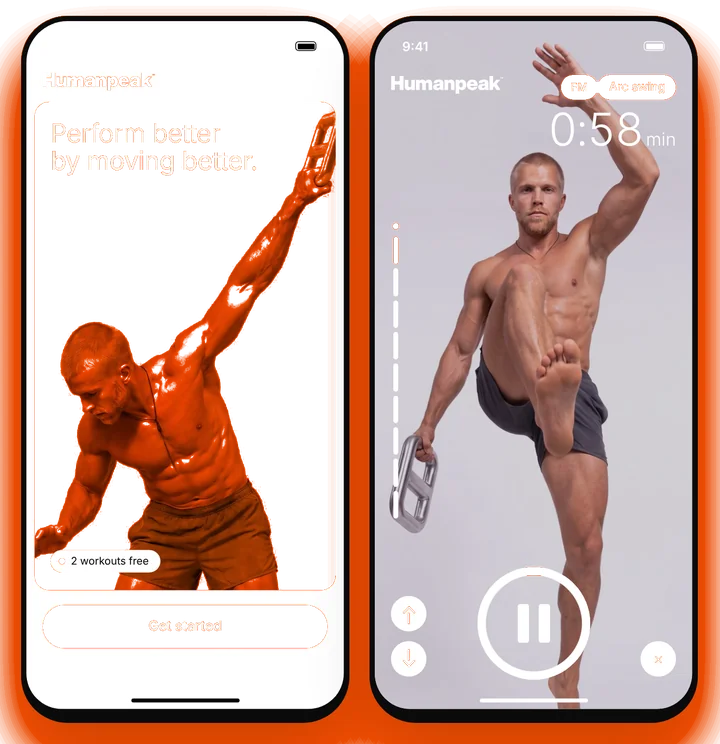
What does usable range mean for both athletes?
The hypermobile athlete has range they cannot control. The stiff athlete has control over a range that is too small. The fix for both runs through the same principle: range is only worth having if you can produce force in it.
Afonso and colleagues pooled 11 studies comparing strength training with stretching for range of motion. Loaded training through a full range improved range as much as stretching did [9]. The body does not need to be pulled into a position to learn it. It needs to work there. That matters for the stiff athlete because it means the time spent stretching could be spent loading, with the same range outcome and a strength outcome on top.
It matters for the hypermobile athlete for the opposite reason. Stretching takes a joint to its end range and asks the passive tissue to hold it there. For a lax joint, that is practicing the exact position where the active system is weakest. Loaded range, especially controlled loading near end range, teaches the muscle and the nervous system to own the position instead of hanging on the ligament.
The injury data points the same way. Lauersen, Bertelsen and Andersen pooled 25 randomized trials with 26,610 participants and 3,464 injuries. Strength training reduced sports injuries to less than a third, with a risk ratio of 0.315. Proprioception training reduced them as well, with a risk ratio of 0.550. Stretching showed no effect, with a risk ratio of 0.963 [10]. These are population averages across many sports, not a prescription for any one athlete, and they are not a promise. They are the clearest evidence available that what protects a joint is strength and control, not length.
| WHAT THE CLAIM SAYS | WHAT THE RESEARCH SHOWS |
|---|---|
| Joint instability is directly linked to fascial health | Hypermobility is a heritable connective tissue trait. Position sense is poorer and, in one clinical sample, tendon stiffness is lower. No study describes a "fascial health" state that treatment restores [2, 4, 5] |
| Hypermobile athletes should work on fascia | Research links strength and proprioception training to fewer injuries. Stretching alone showed none [10] |
| Stiffness is bad | Tendon stiffness correlated with faster force development and higher jumps in trained men [6] |
| You need to stretch to gain range | Loaded training improved range of motion as much as stretching [9] |
| Hypermobility raises injury risk everywhere | The meta-analysis found raised knee risk in contact sports and no raised ankle risk [3] |
How do you train a hypermobile joint?
Here is the honest framework, and it is the same one for a lax knee and a stiff hip, with the emphasis reversed.
Build strength through the full range you have. Not the range you can be pushed into. The range you can move into and out of under control. Loaded training builds range and strength together [9].
Load the tendon hard. Tendon stiffness responds to intensity. That means heavy strength work, slow and controlled, in the main lifts, and plyometrics once the base is there. The light, fast loading that trains coordination and elasticity does not reach the tendon's adaptation threshold [7, 8]. This is a case where the heavy barbell is not optional.
Train the sense of position. Position sense is the deficit the research actually found in hypermobile people [4], and proprioception training is one of the interventions linked to fewer injuries [10]. That means loading joints in positions and directions you did not plan, with feedback that tells you when alignment is off, at loads low enough that the lesson costs nothing.
Stop at the end of control, not the end of range. For the hypermobile athlete, end range is a place to visit under load, not a place to rest. For the stiff athlete, end range is a place to earn, under load, one controlled rep at a time.
- FOCUS: control at end range
- LOAD: heavy and slow for the tendon, light and fast for coordination
- TEMPO: owned, not hung
How Humanpeak trains this
Mobility only counts when you can control and load it. That is the sentence under every flow in the Humanpeak method, and it applies to both athletes in this article. The hypermobile one needs to own the range. The stiff one needs to earn it. Neither gets there by stretching or rolling.
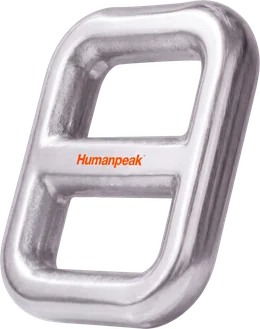
The Humanpeak™ Movement Tool weighs 2.2 kg, cast in one piece from aluminum, with its mass sitting outside the grip. Accelerate it and the offset mass creates torque that pulls off-axis and changes direction mid-movement, so your joints have to find and hold alignment against a load that arrives from an unplanned direction. When the alignment is off, you feel it in that rep: the feedback principle. For a joint with poor position sense, that is the information the nervous system has been missing. For a joint that does not move far enough, the rotational flows take it through its range under light load, where range is built rather than borrowed. The 12-Week Movement Protocol runs this through three phases, Restore, Build and Perform, in 5 workouts per week of about 20 minutes each, across over 450 movement flows. Every flow combines mobility, control and targeted fascial loading through multidirectional movement.
What the Movement Tool does not do: build tendon stiffness. That takes heavy load, and the research is clear on the threshold [7, 8]. Heavy load builds how much force you can create. The Movement Tool trains how fast you can create it, plus elasticity, control, coordination and force transfer. A hypermobile athlete needs both, and this is the layer most training leaves out. The principles behind Humanpeak are established training science. Studies on the specific tool are still to come.
The reel was right that your connective tissue is involved. It was wrong about what to do with it. You do not restore a lax joint. You surround it with strength, stiffen the tendon that serves it, and teach your nervous system exactly where it is.
Move better. Perform better.
Fact check
Frequently asked questions
Humanpeak follows clear sourcing guidelines: we rely on peer-reviewed studies, scientific institutions and professional bodies, and aim for primary sources. Spotted an error? Write to us.
This article is for educational purposes only and does not replace medical advice. If you have symptoms, talk to a doctor.


