Massage vs Training: Why the Relief Fades, and What Makes It Last


Pressing changes how it feels. Loading changes what you can carry.
You know the moment. The therapist finds the spot, holds the pressure, and something lets go. You get up from the table and your hip moves like it hasn't in weeks.
By the next week it's back.
That isn't a failure of the massage, and it isn't a failure of you. It's the difference between two things that both get called relief. One changes how the tissue feels. The other changes what the tissue can do.
Massage and training do different jobs. Massage gives short-term gains in flexibility and soreness, mostly through the nervous system, while the tissue itself measures the same afterwards. Training under load builds range, control and the capacity to carry force, and those changes last for months. Use massage to arrive at a session. Use training to change your body.
What happens when a knot lets go
The most common explanation for that melting feeling is a good one: your nervous system stops holding tension it had been holding on to. Pressure floods the receptors in skin, fascia and muscle with input, and the nervous system answers by turning down tone and protection. You feel looser because, for now, your body allows you to be.
What the tissue does is a different question. In a randomized cross-over study, 29 healthy people received a deep soft-tissue massage to the calf. Researchers measured calf stiffness and ankle range on an instrumented footplate before the massage, right after and 30 minutes later. Neither changed [2]. The calf felt different. Mechanically, it was the same calf.
Stretching shows the same pattern from the other side. Across 65 studies, repeated static stretching mainly increased how much stretch people tolerated, while the length of their muscle fibers stayed the same [3]. The body didn't get longer. It agreed to go further.
So the feeling is real. It's information from your nervous system, and information can change in minutes. Structure can't.
What massage is good for
Massage has its place, and the data show where it is. A meta-analysis of 29 randomized studies with 1,012 participants found small but real improvements in flexibility and in delayed-onset muscle soreness after massage. It found no evidence of better strength, jump, sprint, endurance or fatigue [1].
- Feeling ready before a session: yes, for a while.
- Less soreness in the days after: a little.
- More force, speed or jump: no evidence.
That makes massage a useful tool. It just isn't a training plan. And physiotherapists who combine hands-on work with exercise know that better than anyone.
Why the tightness keeps coming back
If the change sits mostly in what your nervous system allows, it resets. Your body returns to the range it trusts. That's why the same hip asks for the same treatment next week, and the week after.
Tightness is often a message, not a defect. Your body guards a range it can't yet control under load. Pressing makes that message quieter for a while. Training gives your body a reason to stop sending it, because the range becomes one it can actually hold.
If the same tight spots keep returning, the question isn't where to press next. It's what your training never asks of that area. More on that loop: why pain keeps coming back.
What training changes that massage can't
Loading reaches what pressure can't. A meta-analysis of resistance training found it improved range of motion about as much as stretching did, with the gains coming from training with external load; body weight alone didn't reach significance [4]. Range you build under load comes with the strength to hold it.
Loading also reaches the layer massage only presses on. Fascia doesn't just wrap your muscles, it transfers force. In animal studies with the surrounding fascia intact, the force measured at the two ends of the same muscle differed by up to about 23 percent, because the connective tissue carried part of the load away [6]. Roughly a fifth of your force is transmitted through connective tissue rather than the tendon, yet most training doesn't load that layer deliberately. A massage moves over it. Rotation, braking and quick changes of direction load it, so it learns to carry force in the ways your sport demands.
And capacity lasts. In a trial on tennis elbow, a cortisone injection gave the best results at six weeks, then the complaint came back for most of those patients. Physiotherapy with exercise did better over the long run [5]. Fast relief and lasting change came from different inputs.
Treatment gives you your movement back. Capacity lets you keep it.
Fascia makes up about a fifth of you. Our protocol trains it in every direction: 20 minutes, 5 times a week.
Start the protocol 14-day money-back guarantee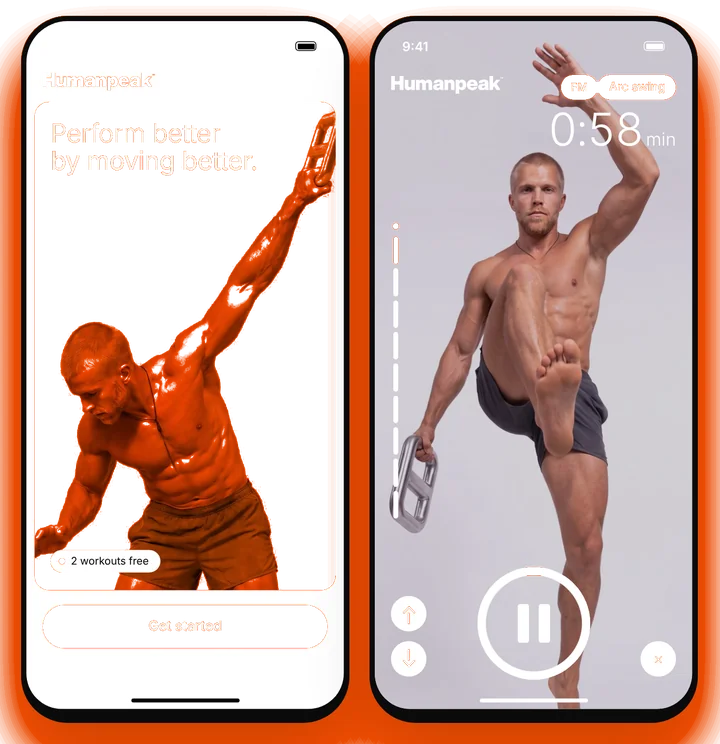
Heavy load and fast load
Not all training reaches the same layer. Heavy strength work builds how much force you can produce. Keep it. Fast, rhythmic, multidirectional loading trains something else: how quickly that force arrives, how it travels through the chain and how well your body absorbs and returns it in a cut, a landing or a throw.
Think of a defender planting to change direction. The force has to be braked in the foot, carried through the hip and redirected through the trunk, in a fraction of a second, from an angle the athlete didn't plan. No table prepares that moment. Neither does a bar that only moves up and down. Your sport never asks for the same rep twice. Your training does.
You've built strength. Now make it transfer. The elastic side of that is in elastic recoil training.
How to use both
The useful position isn't anti-massage. It's anti-substitution. Six principles:
- Use massage as an opener. If pressure makes a position accessible, that's your window.
- Own the range you borrow. Take it straight into controlled movement while it lasts, so it becomes range you can use in a cut, not only on a table.
- Load it in every direction. Rotation, diagonals, lateral steps and changes of direction, because your sport loads you that way.
- Judge by how long it lasts. If the same spot needs the same treatment every week, the input is managing a symptom, not building capacity.
- Keep your strength work. Movement training adds the layer around it, it doesn't replace it.
- Acute? Calm it down first. Then build. Pain that is severe, wakes you at night or keeps getting worse belongs with a physician or physiotherapist.
The same logic applies to the roller: foam rolling vs movement.
How Humanpeak trains what massage can't reach
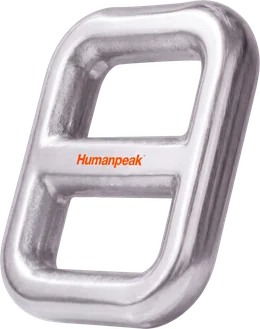
Humanpeak is built for the training side of this article. The 12-Week Movement Protocol runs 5 workouts per week, about 20 minutes each, in three phases: Restore, Build, Perform. You train with the Humanpeak™ Movement Tool (2.2 kg). Every flow combines mobility, control and targeted fascial loading through multidirectional movement, so the range you gain becomes range you can control and load.
It doesn't replace your training, and it doesn't replace treatment when you need it. It adds the layer between the two: capacity, in every direction.
The principles behind Humanpeak are established training science. Studies on the specific tool are still to come.
Frequently asked questions
Humanpeak follows clear sourcing guidelines: we rely on peer-reviewed studies, scientific institutions and professional bodies, and aim for primary sources. Spotted an error? Write to us.
This article is for educational purposes only and does not replace medical advice. If you have symptoms, talk to a doctor.

Related articles


