Strength Training After 40: What Actually Changes


Strength training after 40 does not stop working. That is the first thing worth saying plainly, because most content aimed at this decade begins with decline and sells a rescue. The training still works. What moves is the limiting factor — the quality that runs out first and quietly decides what the body can and cannot do on a Tuesday morning.
For most of the first forty years, the answer to almost every physical question is more strength. After 40, that answer stays useful and stops being sufficient. Four variables start to separate: how fast force can be produced, how well elastic tissue stores and returns it, how much range is actually available under control, and how the week is built around the session. None of them are treated by lying still.
Strength training after 40 still works — what changes is the limiting factor. Maximal strength holds up comparatively well, while power, elastic recoil, usable range and weekly consistency decline earlier or get squeezed first. Training that stays only heavy, slow and linear keeps sharpening the quality that fades last.
What actually changes in strength training after 40?
The popular model is that muscle disappears and everything follows from that. The measured picture is less tidy. In the Health, Aging and Body Composition study, annual leg strength loss ran between 2.6% and 4.1% depending on group — roughly three times faster than the loss of leg lean mass, which sat near 1% per year [1]. The same study reported something more uncomfortable: gain of lean mass was not accompanied by maintenance or gain of strength [1].
Strength and size come apart. European consensus criteria for age-related muscle decline were rewritten around that fact, moving low muscle strength to the front of the definition because strength predicts adverse outcomes better than mass does [6]. The body is not simply losing tissue. It is losing access to the tissue it has.
That reframes what training after 40 is for. Four capacities move on different timelines, and they move in a specific order.
- Power and speed. The product of force and velocity declines earlier and more rapidly than strength with advancing age [2]. It is the first to go and the last to be trained.
- Elastic return. Tendon stiffness and material strength change with age, and cross-linking accumulates in the collagen [4]. The spring gets less efficient before the motor gets weaker.
- Usable range. Force can only be expressed in positions the body can reach and control. Range that is not visited regularly stops being available under load.
- Weekly capacity. Aerobic capacity does not decline in a straight line — the longitudinal rate accelerates markedly with each successive decade [5]. The base that carries the week erodes faster than the lift that fills one hour of it.
One caveat belongs here, early. Most of the longitudinal data above comes from adults in their seventies and older, because that is where effects are large enough to measure cleanly. The forties are where the slope begins, not where the deficit shows. That is a prevention argument, weaker than a scare — and the true one.
Power fades before strength does
Muscle power is force multiplied by the velocity at which it is produced. It is what closes the gap when a foot catches a curb, and what turns a heavy bag into a controlled lift rather than a slow negotiation. Skeletal muscle power has been shown to decline earlier and more rapidly than muscle strength with advancing age, and peak power has emerged as a predictor of functional limitation in its own right [2].
The size of that difference is the part worth remembering. Older adults with low muscle power output carried a two to three fold greater risk of significant mobility impairment than individuals with low muscle strength [2]. The quality most training programs never address is the one most closely tied to whether the body still does what it is told.
So does training for power beat training for strength? Partly, and the honest answer has edges. A 2022 meta-analysis pooled 13 randomized trials comparing power training with traditional strength training in healthy, community-dwelling older adults. Power training was associated with a modest improvement in physical function, a standardized mean difference of 0.30, and a moderate effect on lower-body power. Strength, muscle mass, gait speed and balance showed no significant difference, and the authors rated the certainty of evidence as low [3].
- QUALITY: POWER
- EVIDENCE: MODEST, LOW CERTAINTY
- IMPLICATION: SHIFT THE MIX
That is not a case for abandoning strength work. It is a case for adding a quality most people over 40 have quietly removed. Heavy and slow stays in the plan. Fast and light has to come back — and force does not require a heavy implement, because force is mass times acceleration. A light tool moved with real intent produces real peak force, and builds power, elastic quality and force endurance. It does not build maximal strength or size the way heavy progressive loading does, and should not be sold as if it did.
The springs: what happens to tendon and elastic tissue
Movement that feels springy is not a personality trait. It is a mechanical property. Tendon and series-elastic tissue store energy on the way down and return most of it on the way up, which is why a well-timed step costs less than a deliberate one.
With age, that system changes measurably. A review of tendon aging and exercise reports reduced tendon modulus and material strength, alongside a substantial increase in glycation-derived cross-links, while tendon size and collagen content stay comparatively stable [4]. The material is altered rather than lost — which is why the felt experience is stiffness rather than weakness.
The same review points to the input that changes the picture. Resistance training can increase tendon stiffness and modulus and may reduce the amount of glycation, so that loading tends to counteract the effects of aging on tendon [4]. Note the verb. Loading. Not rolling, not pressing, not being worked on. Passive input does not supply the mechanical signal that connective tissue responds to.
In practice this is the argument for bounce, rebound and rhythm inside a session that would otherwise be entirely controlled. Elastic quality is trained by cycles of loading and release, at speed. Stored. Returned. Repeated.
Built around fascial lines. 20 minutes per session, 5 times a week, guided step by step in the app.
Start the protocol 14-day money-back guarantee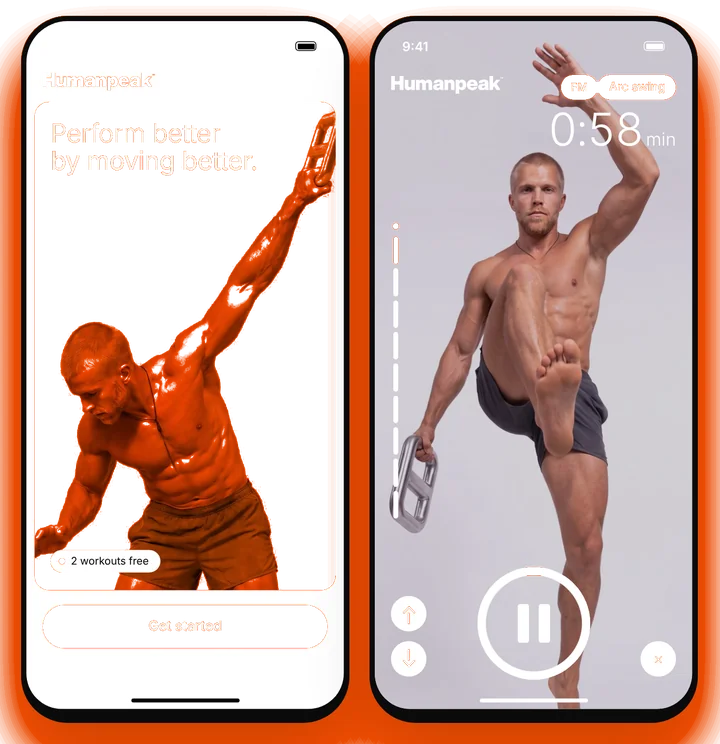
Range is the gate on everything else
Power and elasticity are only useful inside a range the body can reach and control. This is a reasoning claim rather than a trial result, and should be read at that level. A hip that no longer rotates internally does not stop producing force. It produces force somewhere else, usually one segment up or down the chain.
Two things narrow after 40. Training becomes specialized, so the range visited each week shrinks to a few favored patterns. And schedules become sagittal — sitting, walking, driving, lifting straight up and down. Most training is forward and back. Most of life, and all of sport, is rotation.
The distinction that matters is between passive range and controlled range. Being pushed into a position by a strap or another person tells you the tissue tolerates it. Getting there under your own control, and producing force once you arrive, is what makes the range usable — the logic behind mobility vs flexibility and behind usable range as usable strength.
Public health guidance has moved in the same direction. Alongside aerobic and muscle-strengthening minimums, the WHO recommends that older adults perform varied multicomponent activity emphasizing functional balance and strength on three or more days per week, specifically to maintain functional capacity [7]. Multicomponent is the operative word. Not one quality, trained harder.
After 40, the week matters more than the session
The decade between 40 and 50 is rarely limited by knowledge. It is limited by Tuesday. Work expands, families expand, and the training week compresses into two ambitious sessions that carry everything. That structure fails in a predictable order: mobility goes first, aerobic work second, and the heavy session survives longest because it feels most like training.
That order is exactly backwards relative to what declines. Aerobic capacity does not fall at a fixed rate — the longitudinal decline in peak oxygen uptake accelerates markedly with each successive age decade [5]. The base that makes everything else repeatable is the thing quietly being dropped.
The floor is not high. The WHO recommends 150 to 300 minutes of moderate-intensity aerobic activity per week, or 75 to 150 vigorous, plus muscle-strengthening activity covering all major muscle groups on two or more days [7]. Most people over 40 do not miss this because their program is wrong. They miss it because their program does not fit.
| What gets cut first | What it actually costs |
|---|---|
| Mobility and rotation work | The range that lets force be expressed anywhere but straight ahead |
| Easy aerobic minutes | The base whose decline accelerates fastest with each decade [5] |
| Fast, light, springy work | Power and elastic return — the qualities that fade earliest [2][4] |
| Heavy compound lifting | Usually the last thing cut, and the quality that holds up longest [1] |
Frequency solves what intensity cannot. Short sessions spread across five days of the week touch all four qualities by design. It also removes the recovery problem at the source: nothing needs three days of recovery if nothing was maximal. Consistency beats intensity — not as a slogan, as scheduling arithmetic. See how a short, frequent training week is built.
How to rebuild the mix after 40
Nothing here requires abandoning what already works. It requires putting back the qualities removed when training got specialized and time got short. Five adjustments, ordered by how strongly the evidence supports them.
- Keep strength training. It is the quality with the deepest evidence base and the slowest decline, and it remains the floor everything else stands on [6][7].
- Add speed back. One or two blocks per week where the intent is acceleration rather than load — light implement, full intent, clean positions [2][3].
- Load the springs. Rebound, hop, swing and rotate through cycles of stretch and release, so tendon and elastic tissue receive the mechanical signal they respond to [4].
- Train range under control. Active, weight-bearing, rotational — reaching positions rather than being placed into them [7].
- Protect the frequency before the intensity. Meet the weekly aerobic and strengthening minimums first, then make individual sessions harder [7].
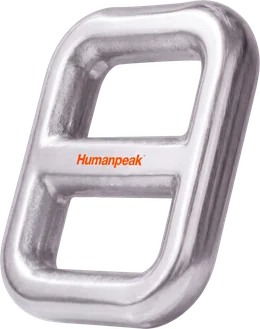
This is the structure Humanpeak's 12-Week Movement Protocol is built on: 5 workouts per week, about 20 minutes each, across three phases (Restore, Build, Perform), with one light tool, the 2.2 kg Humanpeak™ Movement Tool, as a layer on top of the training you already do. Not because short training beats long training, but because a week that happens beats a week that was planned.
The mix shifts with age. That is the whole finding, and it is a better finding than the alternative — because a mix can be changed. Strong. Elastic. Connected.
Training after 40 is not a story about decline management. The data describe a change of order: power and elastic quality move first, range narrows quietly, aerobic capacity slides faster with each decade, and maximal strength — the quality most programs are built around — gives ground last [1][2][5]. Training that addresses only the last one is well built for the wrong problem.
The correction is not harder. It is broader and more frequent. Put speed back. Load the springs. Visit the ranges. Keep the week intact. Move better. Perform better.
Fact check
Frequently asked questions
Humanpeak follows clear sourcing guidelines: we rely on peer-reviewed studies, scientific institutions and professional bodies, and aim for primary sources. Spotted an error? Write to us.
This article is for educational purposes only and does not replace medical advice. If you have symptoms, talk to a doctor.

Related articles


