Does Fascia Training Work? Yes, If You Load It. The Rest Is Hype.


Fascia isn't trained by rolling on it. It's trained by loading it.
Fascia training has a reputation problem. Half the internet sells it as the secret behind every great athlete. The other half calls it marketing. Both skip the question that matters to you: can training aimed at your connective tissue make you move faster, more elastic and with more of your force arriving where it counts?
Here is a simple way to see it. Your biggest hip muscle doesn't only pull on a tendon. In dissections, the gluteus maximus attached so broadly to the fascia of the thigh that the band running down to the knee could be seen as its tendon [6]. Train the glute in a straight line and it gets bigger and stronger. How well its force travels through that sheet, across the hip and into a sprint, a shot or a cut is a different quality. Most programs build the first and hope for the second.
So yes, fascia training works. When it means loading, not pressing.
Fascia training works when it means loading your connective tissue, not pressing on it. Connective tissue adapts to load over weeks and months, with the biggest structural change after heavy loading. Fast, elastic, multidirectional training targets the function athletes need: rebound, control and how force travels through a connected body. Rolling helps you feel better for a while. Loading builds what lasts.
What does fascia training actually mean?
First, the tissue. Sports medicine researchers describe the fascial system as one continuous network of connective tissue that runs through the whole body, including the sheets around and inside muscle, tendons, ligaments and joint capsules [1]. When we say fascial system, that's what we mean.
Second, the question. "Does it work" hides two questions:
- Can the tissue change? Does loading alter how connective tissue is built and how it behaves?
- Does training aimed at it change how you move? Rebound off the ground, control at speed, how cleanly force travels from your feet to your hands.
The answer to both is yes. They just run on different loads, and most of the confusion comes from mixing them up.
Heavy load builds the spring
Connective tissue is not passive packing. The consensus statement describes human tendons getting stiffer under repeated overloading and softer when load is taken away, with changes that show up within weeks [1].
The detail most fascia content leaves out is the dose. A meta-analysis of tendon training studies found that intensity decided the outcome. Programs that loaded above about 70 percent of maximal effort produced a clear increase in tendon stiffness. Lighter programs barely moved it [2].
So if the goal is a stiffer, stronger tendon, heavy load is the tool. Nothing light replaces it. That's why Humanpeak never asks you to stop lifting. You've built strength. Now make it transfer.
Fast, elastic load trains how you use it
Here is where it gets useful for an athlete. The qualities that decide a cut, a sprint or a throw are not tissue measurements. They are functions, and functions respond to training.
A meta-analysis of jump training found countermovement jump height improved by 8.7 percent on average [4]. In the tendon research, the same kind of training gave mixed results on tendon stiffness [2]. Put those two together and the picture is clear: the elastic function improved even where the tendon didn't measurably stiffen. Athletes got better at using the spring they had.
Heavy load builds the spring. Fast, multidirectional load trains how you use it. Two qualities. Your body needs both.
More on the elastic side in elastic recoil training.
Force has to travel
Strength training builds how much force you can produce. But athletic performance depends on how effectively that force travels through your body and into the ground.
That travel is not only a tendon job. In animal studies with the surrounding fascia left intact, the force at the two ends of the same muscle differed by up to about 23 percent. The connective tissue carried part of the load sideways, into neighboring muscles and along the chain [3].
Roughly a fifth of your force is transmitted through connective tissue rather than the tendon, yet most training doesn't load that layer deliberately. Back to the glute: a straight-line hip thrust builds the muscle. A rotational throw, a crossover step or a cut loads the sheet it pulls on, from a new angle every time. That is the layer fascia training is for. More in power without more muscle.
Fascia makes up about a fifth of you. Our protocol trains it in every direction: 20 minutes, 5 times a week.
Start the protocol 14-day money-back guarantee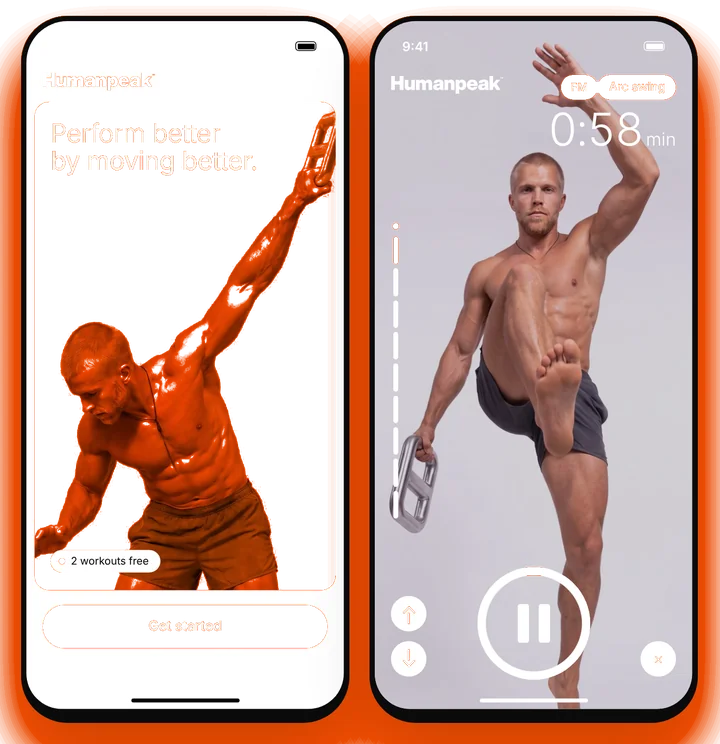
Where fascia training gets oversold
Fascia training doesn't need big promises. The real version is strong enough. Three claims go further than the research, and each has an honest version that is still worth your time.
Rolling and release. Rolling can give you short-term range and comfort, and that relief is real. A review of how rolling works found the effect most likely runs through the nervous system and lower muscle tone, not through releasing fascia [5]. So use it to feel better. Load the tissue to change what it can carry. Pressing changes how it feels. Loading changes what you can carry.
One session. A session can change how your body feels. Connective tissue adapts over weeks and months [1]. Think in training blocks, not in workouts.
Light work instead of heavy work. Light, fast, multidirectional training trains elasticity, control and force transfer. Building tendon stiffness takes heavy load [2]. They are partners, not rivals.
How to train fascia that performs
Five principles turn fascia training from a trend into training:
- Load it, don't just press it. Movement under load is the signal connective tissue adapts to.
- Every direction. Rotation, diagonals, lateral steps and changes of direction. Your sport never asks for the same rep twice. Your training does.
- Elastic reversals. Quick turns from loading to unloading, so the spring learns to store and return energy.
- The whole chain. From the foot through the hip to the opposite shoulder, so force learns to travel, not just to be produced.
- Weeks, not sessions. Short, frequent sessions with a clear progression, on top of your heavy lifting.
How Humanpeak trains the missing layer
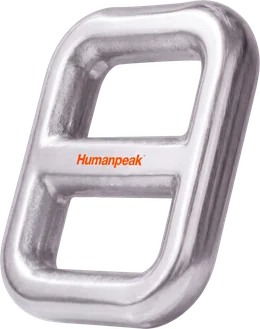
Humanpeak is fascia training in the loading sense. The 12-Week Movement Protocol runs 5 workouts per week, about 20 minutes each, in three phases: Restore, Build, Perform. You train with the Humanpeak™ Movement Tool (2.2 kg). Every flow combines mobility, control and targeted fascial loading through multidirectional movement to train your body as one connected system.
The division of labor is simple. Your heavy training builds how much force you can create. Humanpeak trains how that force travels: elasticity, control, coordination and force transfer, in every direction your sport asks for. It sits on top of your training. It doesn't replace it.
The principles behind Humanpeak are established training science. Studies on the specific tool are still to come.
Frequently asked questions
Humanpeak follows clear sourcing guidelines: we rely on peer-reviewed studies, scientific institutions and professional bodies, and aim for primary sources. Spotted an error? Write to us.
This article is for educational purposes only and does not replace medical advice. If you have symptoms, talk to a doctor.

Related articles


