Proprioception Training: The Sense You Never Think About


There is a sense that never makes the list of five. It reports where the limbs are, how fast they are moving and how much force they are producing — continuously, in the background, without being asked. Proprioception training is the deliberate practice of sharpening that report. It is also the reason a ten-second balance test spreads so far online: it makes an invisible capacity briefly visible, in one attempt, with no equipment.
The research picture is more interesting than the reels suggest. Position sense responds to practice fast, and a measurable part of the gain arrives in the first session [1][2]. Balance and functional training carries high-certainty evidence for reducing the rate of falls in older adults [3]. And the popular assumption that everyone's position sense quietly erodes after fifty turns out to be less settled than it sounds [4].
Proprioception training is structured practice that sharpens the body's sense of joint position, movement and force — usually through balance, single-leg and controlled-range work. A systematic review of 51 studies reported an average 52 percent improvement across proprioceptive outcomes, with gains measurable after one session and most of the change arriving early in a program.
What Is Proprioception Training?
Proprioception is the body's internal position report. Receptors in muscle, tendon, joint capsule and skin feed a continuous stream of information about joint angle, movement direction, movement speed and effort, and the nervous system assembles that stream into a working map of where the body is and what it is doing. Proprioception training is any structured practice that deliberately loads and sharpens that map rather than leaving it to run on autopilot.
- POSITION SENSE. Where a joint is without looking at it. Tested by matching one limb's angle with the other, eyes closed.
- MOVEMENT SENSE. Detecting that a joint has started to move, and in which direction — the quality that catches a stumble before it becomes a fall.
- FORCE SENSE. How much effort is being produced. This is what makes a landing quiet or loud, a step precise or approximate.
In the research literature these are trained through several distinct routes: active movement and balance work, passive movement with and without vision, somatosensory stimulation such as vibration, and discrimination tasks that ask the body to tell two similar positions apart [1]. Active balance and coordination training is the largest and most practical category, and the one that translates into a training week.
That distinction matters. The honest version is not that connective tissue is remodeled by balancing, but that the body gets better at reading and using signals it already produces. For the tissue side, see the guide on fascia and proprioception.
Why the Ten-Second Balance Test Travels So Far
The most-shared proprioception content is not training content. It is testing content: stand on one leg, start a timer, find out something about yourself in ten seconds. The format works because the underlying study is real and the finding is blunt.
In 1,702 adults aged 51 to 75, researchers recorded whether each person could hold a ten-second one-legged stance, then followed them for a median of seven years. Just over a fifth — 20.4 percent — could not complete the test. Over follow-up, 7.2 percent of the cohort died: 4.6 percent of those who passed the test and 17.5 percent of those who did not. After adjustment for age, sex, body mass index and existing conditions, failing the test was associated with a hazard ratio of 1.84 for all-cause mortality [6].
- COHORT: 1,702 ADULTS
- AGE: 51–75
- FOLLOW-UP: ~7 YEARS
- ADJUSTED HR: 1.84
Read that carefully, because the reels usually do not. This is an observational association, not evidence that practicing single-leg stance extends life. Balance is a summary marker: it collects strength, coordination, vestibular function, vision and general health into one visible result. Worth knowing. Still a marker, not a mechanism, and one failed attempt on a kitchen floor is not a diagnosis.
The authors' own framing is the useful part: balance declines become relevant from the mid-fifties, and a test this cheap adds information that a standard physical exam otherwise misses [6]. Test it. Note it. Then train it.
Does Proprioception Actually Decline With Age?
This is where the popular story and the measurement diverge. A 2026 study compared 37 younger adults, aged 19 to 32, with 35 older adults, aged 53 to 71, across a battery of standard upper-limb proprioceptive tasks. The age effects were not uniform. On some outcomes the older group performed worse, on others the two groups were indistinguishable, and on some tasks the older participants performed better [4].
The authors' conclusion is worth quoting in substance: age-related changes in proprioception appear limited in size, dependent on both the task and the specific outcome measured, and the tasks commonly used to assess proprioception do not give consistent evidence of impairment with age. Associations between different proprioceptive measures were negligible to weak — which means the field does not yet have one clean number called 'position sense' to track [4].
So the case for training does not rest on decline. It rests on demand. Balance under challenge — one leg, uneven ground, eyes shut, head turning, a load moving away from the midline — is a composite skill that fades when it is never asked for, at any age. What disappears in an adult life is not the sense. It is the situations that require it.
Built around fascial lines. 20 minutes per session, 5 times a week, guided step by step in the app.
Start the protocol 14-day money-back guarantee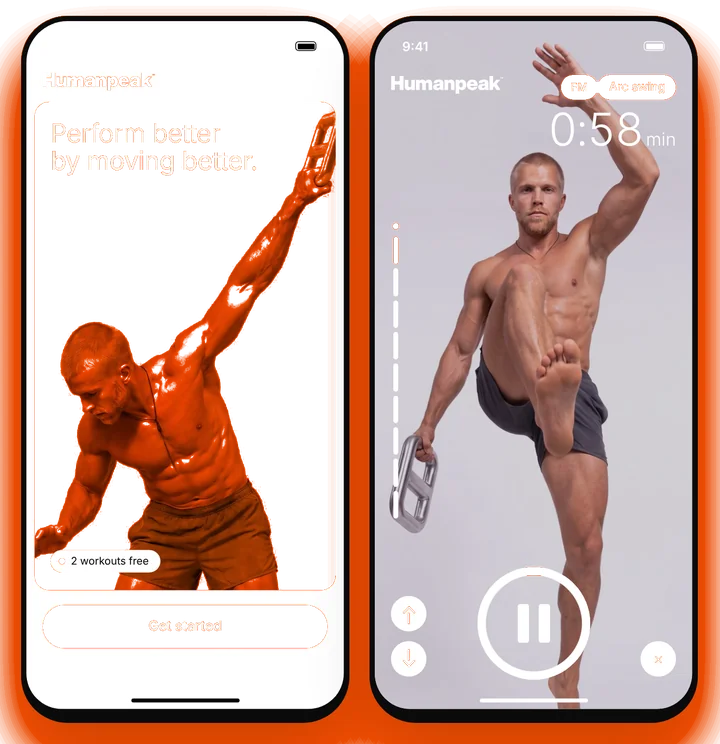
What Improves Proprioception, and How Quickly
This is the part of the evidence that is genuinely encouraging. A systematic review of 51 studies covering 1,854 participants found that proprioceptive training produced an average improvement of 52 percent across all outcome measures. Joint position and target-reaching training consistently improved joint position sense, averaging 48 percent improvement and reaching 109 percent in individual outcomes, and protocols that combined active and passive movement with and without visual feedback performed best [1].
The timing is the more useful finding. A systematic review of the learning dynamics of proprioception training pooled 106 studies and 343 participant-outcome groups. Single-session protocols produced meaningful immediate improvement. Multi-session protocols showed roughly 70 percent of their final change already present at the midway point — fast early gains, then slower refinement. Effects were largely maintained at follow-up of at least one week [2].
| Time frame | What the evidence shows |
|---|---|
| One session | Meaningful immediate improvement in proprioceptive acuity in single-session protocols [2]. |
| Halfway through a program | About 70 percent of the total change is already present at the midpoint [2]. |
| 11–12 weeks, three times a week | The dose associated with the largest balance gains in adults 65 and over: 36–40 sessions of 31–45 minutes [5]. |
| A week after the last session | Gains largely retained at delayed follow-up across the studies that tested it [2]. |
The dose data comes from a meta-analysis of balance training in healthy older adults, which found the strongest effects at 11 to 12 weeks, three sessions per week, 31 to 45 minutes per session, and a total of 36 to 40 sessions. Proactive balance — the ability to anticipate and prepare for a disturbance — showed the largest improvement of all balance categories [5].
Two caveats keep this defensible. Median group sizes in the proprioception training literature are around 15 participants, training methods vary widely, and the reviews explicitly decline to name one optimal protocol [2]. And 'improved on the test' is not automatically 'improved in the game'. Fast. Early. Incomplete.
What It Changes: Falls, Ankles, Control
The strongest outcome data does not come from laboratory position-matching. It comes from falls. A Cochrane review of 108 randomized trials and 23,407 community-dwelling older adults found that exercise reduces the rate of falls by 23 percent, and that balance and functional exercises specifically reduce the rate of falls by about 24 percent — rated high-certainty evidence. Programs combining several exercise types, usually balance plus resistance training, probably reduce falls by around 34 percent, at moderate certainty [3].
That is one of the more solid findings in exercise science, and it points somewhere specific: the balance and coordination component is not the warm-up. It is the active ingredient.
- THE ANKLE CASE. Sports medicine has concentrated on the ankle, where proprioceptive training programs in athletic populations have been pooled in a systematic review and meta-analysis examining ankle sprain incidence and recurrence [7].
- THE TRANSFER QUESTION. Improvements on one proprioceptive assessment correlate with improvements on others, which suggests a shared mechanism rather than pure test-specific practice [2].
- THE HONEST GAP. The falls evidence comes from adults averaging 76 years of age. Extending it to a 45-year-old is reasoning by analogy, not by data.
For a performer in the middle decades, the argument is simpler than risk reduction. Control is a capacity you either practice or lose access to. The body keeps what it is regularly asked for.
How to Train Position Sense
No balance boards required, no separate discipline, no second program. Position sense is trained by making ordinary movement harder to guess: fewer points of contact, less visual information, more rotation, slower control through a fuller range.
- Reduce the base. One leg, split stance, or one hand and one foot. The moment the base narrows, the correction system has to work.
- Remove vision selectively. Close the eyes for a few seconds in a stable position, then reopen. Vision covers for a weak position sense until it is taken away.
- Move slowly through the end of the range. Controlled entry and exit at the edge of a position asks for precision that a fast rep never requires.
- Add rotation. Most training happens in one plane. Turning the body while balancing changes the task completely and reflects how life actually loads the system.
- Change the surface and the tempo, not just the load. Novelty is the input that drives motor learning; repetition of the identical drill stops asking questions.
- Practice often in small doses. Early gains arrive fast, and frequency protects them better than occasional long sessions [2][5].
- FOCUS: CONTROL
- DURATION: 20 MIN
- PLANE: MULTIPLANAR
- BEST FOR: ALL LEVELS
This is the logic the 12-Week Movement Protocol is built on: whole-body flows that shift base, plane and tempo continuously, so the position report stays under load instead of being trained once a week as a novelty. The body trains and refines its control in parallel.
Two more guides sit close to this one: motor learning at any age for how new patterns are acquired, and weak feet for the contact surface where most of the ground information enters.
Proprioception training is not an exotic add-on. It is the practice of keeping the body's position report accurate, and the evidence around it is unusually practical: acuity improves fast, most of the change arrives early, gains hold for at least a week after the work stops, and the balance-and-function category has high-certainty falls data behind it [1][2][3].
What the research does not support is the dramatic version — that the sense inevitably collapses with age, or that ten seconds on one leg is a verdict [4][6]. The measured version is better anyway. Train the base narrow. Train the range slow. Train the plane wide. Precise. Steady. Connected.
Fact check
Frequently asked questions
Humanpeak follows clear sourcing guidelines: we rely on peer-reviewed studies, scientific institutions and professional bodies, and aim for primary sources. Spotted an error? Write to us.
This article is for educational purposes only and does not replace medical advice. If you have symptoms, talk to a doctor.


