Fascia and Proprioception: Your Body Senses Every Step. Teach It More Than One Direction.


Your fascia is wired with nerve endings. Every rep teaches your nervous system a path for force. Most training teaches it one.
Every step starts with information. Before you push off, your foot has already reported how the ground feels, how your weight is spread and where the next move is going. Your ankle, knee and hip add their part. Within milliseconds your body knows where it is, and it organizes the next step before you've had a single conscious thought about it.
That sense is called proprioception. Athletes rely on it in every cut, landing and catch. And it isn't fixed. It gets sharper with the right input, and duller when every rep looks the same.
Proprioception is your body's sense of position, movement and force. It is assembled from receptors in muscle, skin, joints and connective tissue, including fascia. The sense itself is a skill of the nervous system, so it improves with targeted, varied, active movement.
What is proprioception?
Close your eyes and touch your nose. You can do it because your body constantly reports where every part of it is. That report doesn't come from one place. Receptors in muscles, skin and joints send signals, groups of nerve fibers code position and movement together, and the brain refers all of it to a map of your body [1].
Muscle spindles, small sensors inside the muscle that register length and how fast it changes, sit at the center of that system [1]. Skin adds pressure and stretch. Joints add information near the end of their range. And the connective tissue around all of it adds its own stream of signals.
For an athlete this isn't abstract. It is the difference between a landing that organizes itself and one you have to save. Between a cut that holds and an ankle that rolls.
Your fascia is part of the sensor network
For a long time fascia was treated as packing material. It turns out to be well wired. A systematic review of 23 anatomical studies concluded that fasciae carry a dense nerve supply with its own distribution, made up especially of endings that sense position and movement and endings that signal threat [2].
Some of those endings are specialized. Receptors that respond to pressure and stretch were found in the fascia of the upper limb, in the palm and in the plantar fascia under your foot [2]. Other regions mainly carry simpler free nerve endings. So the fascial sensor network isn't uniform. It is richer in the places where you touch the world: your hands and your feet.
When you move, connective tissue stretches, shears and slides between layers. The endings inside it respond to that deformation and add it to what muscle, skin and joints already send. Movement creates the signal. More directions create more of it.
Fascia doesn't run proprioception on its own. Muscle spindles lead [1]. But fascia is part of the network, and that is one more reason to train your body as one connected system instead of a collection of parts.
It starts at the ground
The foot is the first point of contact in almost everything an athlete does. Sprint, cut, jump, land, throw: force goes into the ground and comes back through the foot. So does information.
The sole of the foot is one of the regions where fascia carries pressure- and stretch-sensitive receptors [2]. Skin and the small muscles of the foot add more. Together they tell your body how the ground feels, where your weight is and which way it is moving, before the hip and trunk commit to the next action.
That is why the way you meet the ground matters. A foot that only ever experiences one surface, one angle and one direction gives your nervous system one kind of information. A foot that lands, turns, pushes sideways and rotates under load gives it the full picture your sport will ask for. More on the foot's role in force in how your feet put force into the ground.
Faster than thinking
This is where proprioception decides performance. When you brake hard, ground forces can reach up to 2.7 times those of the first steps of a maximal sprint start, and they peak within about the first 50 milliseconds of contact [6]. Nobody consciously plans anything in 50 milliseconds.
The quality of that stop, and of the cut that follows, depends on how well your nervous system has learned to read load and organize against it in advance. That is proprioception at work. Not a balance trick, but the reason a body holds its line under force.
Strength matters here. But being strong doesn't automatically mean your body knows how to use that strength in a split second, in a direction it rarely trains. The read has to be trained too.
Fascia makes up about a fifth of you. Our protocol trains it in every direction: 20 minutes, 5 times a week.
Start the protocol 14-day money-back guarantee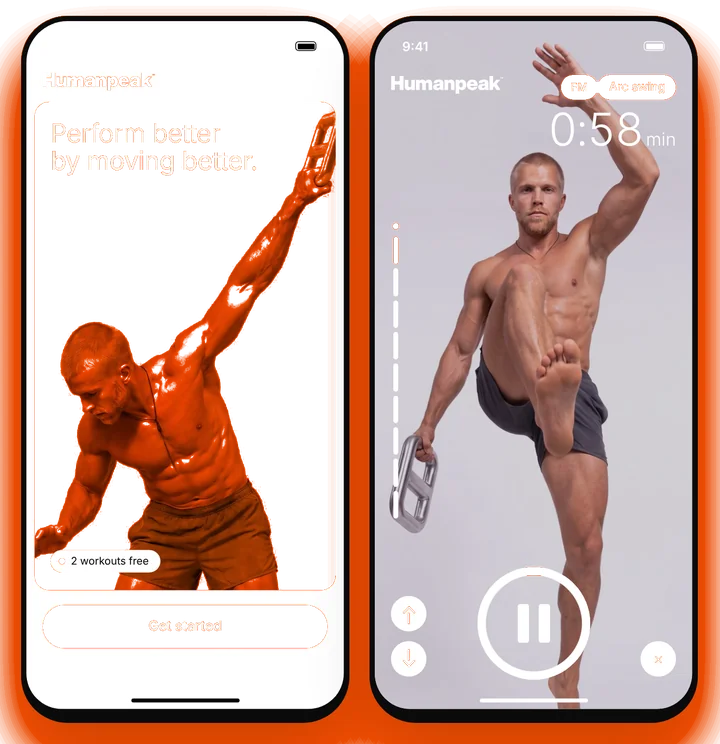
Proprioception is trainable
The evidence here is solid. A systematic review of 106 studies looked at how proprioceptive training works over time. Training that specifically targeted position and movement sense improved accuracy by roughly 23 to 43 percent, compared with 12 to 22 percent for training that didn't target it and 5 to 9 percent for no training. The gains held at follow-ups of a week or more [3]. The numbers come from many different tests and settings, so treat them as a direction, not a promise for your sport.
What changes? Not the number of receptors in your fascia. Nobody has shown that. What changes is how your nervous system reads and uses the signal it already receives. That is motor learning, the same process behind every skill you've built in your sport.
Two findings show where the gains come from.
Attention. Across 73 studies on performance and 40 on learning, focusing on the effect of a movement, on the ball, the target or the object in your hands, beat focusing on your own body parts. It improved performance, retention and transfer, with more efficient muscle activity [4]. Your body organizes itself better when you give it a problem outside the body to solve.
Variation. A meta-analysis of 34 studies found that varied, mixed practice transferred better to new tasks than repeating the same drill in blocks. The effect was clear in lab studies and smaller and less certain in applied settings [5]. The direction still fits what athletes feel on the field. Repetition builds patterns. Variation builds adaptability.
How to train proprioception
Six principles carry most of the effect:
- Move actively. Signals come from movement. Active work through range, under load, gives the system something to read.
- Every direction. Rotation, diagonals, lateral steps and changes of direction ask for information that straight-line training rarely produces.
- Start at the ground. Let your feet feel load from different angles: landing, pushing sideways, turning. The information starts there.
- Focus outside your body. On the tool, the ball or the target, not on your shoulder or your core [4].
- Vary the task. Change angle, grip, tempo and direction, so the system learns to adapt instead of repeat [5].
- Keep it regular. In the studies that checked midway, most of the improvement came in the first half of a program, and it held afterwards [3]. Frequent, short exposure beats the occasional long session.
To go deeper on the training side, read proprioception training for athletes.
How Humanpeak trains the sense of movement
The 12-Week Movement Protocol runs 5 workouts per week, about 20 minutes each, in three phases: Restore, Build, Perform. Every flow combines mobility, control and targeted fascial loading through multidirectional movement.
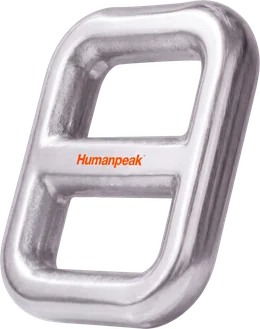
You train with the Humanpeak™ Movement Tool (2.2 kg). Its mass sits outside your grip, so when you accelerate and stop it, it keeps pulling, and the direction of that pull changes through the movement. If your alignment is organized, the force travels cleanly through the chain. If it isn't, you feel it in that exact rep. That is feedback inside the movement, with your attention on the tool instead of your body, and a load that never arrives the same way twice.
It doesn't replace your training. It adds the layer your training leaves out: how your body reads force and organizes around it, in every direction.
The principles behind Humanpeak are established training science. Studies on the specific tool are still to come.
Frequently asked questions
Humanpeak follows clear sourcing guidelines: we rely on peer-reviewed studies, scientific institutions and professional bodies, and aim for primary sources. Spotted an error? Write to us.
This article is for educational purposes only and does not replace medical advice. If you have symptoms, talk to a doctor.

Related articles


