Motor Learning: Why New Movement Changes the Nervous System at Any Age


Coordination usually gets filed under talent, and talent gets filed under youth. Neither filing survives contact with the research. Motor learning — the set of changes in the nervous system that follow practice and outlast the session — is one of the better documented processes in human neuroscience, and it does not switch off at 30, 50 or 70. For motor learning adults are not a special case with a shorter runway. They are the standard case with a different curve.
Age changes the terms, not the capacity. Older adults still acquire new movement sequences and still adapt to new demands, with altered neural recruitment and slower consolidation compared with younger adults [1]. Structural imaging has followed people in their sixties learning a genuinely new skill from scratch and found training-related change in the brain [2]. What follows is what is established, what is only supported, and exactly where the popular version of this science runs past its evidence.
Motor learning is the lasting change in neural control that follows practice: better timing, cleaner coordination, less effort for the same task. It stays available to adults at every age. Older adults acquire and retain new movement patterns, though consolidation is slower and improvements stay close to what was actually trained.
What Is Motor Learning, and Does It Still Work in Adults?
Motor learning is the process by which practice makes a movement more accurate, more consistent and less effortful — and leaves that improvement in place after the session ends. The distinction that matters is between performance and learning. Performance is what happens inside a session, where fatigue, mood and warm-up all interfere. Learning is what is still there two days later, cold, without a demonstration.
The process runs on sensory information. Proprioception — the sense of where the segments are, how fast they are moving and how much force is being produced — supplies the signal against which the nervous system grades its own output [7]. Without that signal there is nothing to correct against, which is why learning a movement and refining a sense of the body are not two separate projects.
The training evidence is more encouraging than the reputation of the field suggests. A systematic review of 51 studies of proprioceptive training found converging evidence of meaningful improvement in somatosensory and sensorimotor function, averaging roughly 52 percent across outcome measures, with the strongest protocols combining active and passive movement with feedback about accuracy [3]. The review also reports evidence of cortical reorganization accompanying those gains.
What Actually Changes When an Adult Learns a New Movement
Three layers move, and they move on different timescales.
- Control. Timing and recruitment reorganize first. The same movement becomes smoother and cheaper before anything visible has changed about the body.
- Calibration. The sensory side sharpens. Position and force sense become more precise, and the estimate the nervous system works from gets closer to reality [3][7].
- Structure. With sustained practice, structural imaging picks up training-related change in the brain — later, smaller, and less permanent than the popular account suggests [2].
The structural evidence is worth stating precisely, because it is the part most often overstated. In a study of older adults around 60 who learned three-ball juggling from scratch over three months, structural MRI detected training-related gray matter change that was not stable — it receded once practice stopped [2]. Read honestly, that is a strong result and a warning at the same time. The nervous system responds to novel skill demands late in life, and it also gives the response back when the demand disappears.
Note what these studies measure. They measure change associated with movement practice. They do not measure a general upgrade of the mind, and none of them was designed to.
Does Age Close the Window on Motor Learning?
No — but it narrows the margins, and the narrowing is specific rather than general. A review of the neural correlates of aging in motor sequence learning and motor adaptation concludes that older adults do learn and do adapt, while showing altered recruitment of the networks involved, reduced gains on more complex sequences, and weaker consolidation of what was practiced [1]. The deficit is concentrated in the offline part — what the nervous system does with a session after it is over — more than in the ability to improve during it.
That points to a program design, not to a limitation. Fewer new variables at once. More repetitions of the same pattern before adding complexity. Daily contact rather than one long weekly session, so that consolidation gets more chances and less time to decay.
The stakes are functional, and here the evidence is unusually solid. A Cochrane review of community-dwelling older adults found that exercise reduced the rate of falls by about 23 percent, with balance and functional training accounting for a 24 percent reduction on high-certainty evidence [5]. Balance training is motor learning delivered under load, in real positions, with real consequences for accuracy.
- VARIABLE: NOVELTY
- LIMIT: ONE AT A TIME
- DOSE: FREQUENT, SHORT
Built around fascial lines. 20 minutes per session, 5 times a week, guided step by step in the app.
Start the protocol 14-day money-back guarantee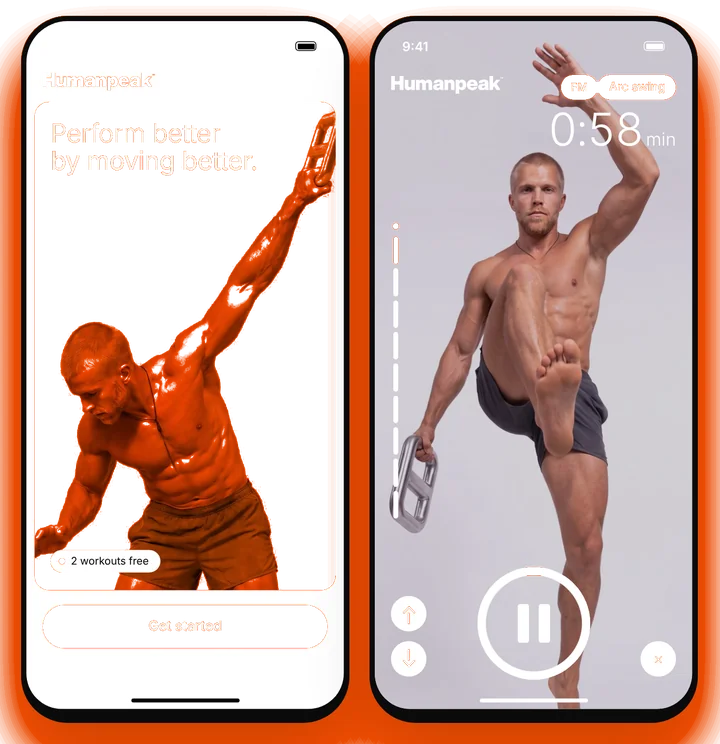
'Movement Trains the Brain': What the Claim Covers
This is the line the clips are built on, and it is true at the level where it was measured. Learning novel, coordinated movement changes motor control, and that change has neural correlates that imaging can find, including in adults past 60 [1][2]. Stated that way, it is defensible and unremarkable to anyone who works in the field.
The overreach starts one step later, when a motor finding is presented as a claim about memory, focus, or protection against cognitive decline. The studies behind the headline used motor outcomes: sequence accuracy, adaptation, movement-related brain measures. Extending them to general cognitive health is not a stricter reading of the evidence — it is a different question that these designs did not ask.
There is a second, more useful correction inside the same claim. Learning requires output. The nervous system needs to produce a movement, register the result, and reduce the error next time. Being stretched, rolled or worked on delivers sensation without that loop, which is why the most effective protocols in the training literature pair active movement with information about accuracy [3]. Active movement instead of passive treatment is not a brand preference here. It is what the mechanism requires.
What Makes Motor Learning Stick
Four conditions decide whether a session becomes a skill.
- Specificity. A systematic review of the learning dynamics of proprioception training found improvements of 23 to 43 percent when training specifically targeted the trained quality, against 12 to 22 percent for non-targeted training and 5 to 9 percent for no training [4]. The body learns what it practices, in the position it practices it.
- Feedback. Movement paired with information about accuracy — a mirror, a video, a coach's cue, one side compared against the other — outperformed movement alone in the reviewed protocols [3].
- Frequency. Roughly 70 percent of the total change in those training programs appeared by the midpoint [4]. Early consistency carries most of the result, which is an argument for daily contact over occasional intensity.
- Retention under real conditions. This is the step almost everyone skips, and the one that separates a demonstration from a skill.
A six-month follow-up of a running gait retraining trial makes the last point concrete. Tested without a cue, the runners showed no significant retention of their new pattern. Given a single verbal reminder to move as they had at the end of the program, they returned a 32 percent reduction in peak tibial acceleration [6]. The pattern had been learned and stored. It had not yet become the default.
That gap between stored and automatic is where most training programs quietly fail. It closes with frequency and with practice in the context where the movement is actually used — not with more explanation.
How to Train So the Nervous System Keeps Learning
A practice built for motor learning looks different from a practice built for load. It is more varied, more frequent, less heavy, and far more concerned with accuracy than with volume. Four rules cover most of it.
- Novel but repeatable. New patterns provide the learning demand; repetition provides the consolidation. Rotate the challenge, keep the structure.
- Whole-body over isolated. Coordination is a relationship between segments. Training parts separately trains fewer of those relationships — the reasoning behind integrated over isolated work.
- Multiplanar, not only sagittal. Most training moves forward and back. Life and sport rotate, and rotation is where control is usually thinnest.
- Short and frequent. Consolidation responds to contact frequency.
That is the logic the 12-Week Movement Protocol is built on: 5 workouts per week of about 20 minutes each, in three phases, Restore, Build and Perform, with the Humanpeak™ Movement Tool (2.2 kg), and whole-body flows that change often enough to keep posing a coordination problem and repeat often enough to solve it.
Precise. Repeated. Owned.
The honest summary is narrower than the viral version and more useful than the pessimistic one. Motor learning is available to adults at every age, the improvements are real and measurable, and they stay close to what was trained. Age slows consolidation and shrinks the margin on complex tasks. It does not close the door.
Which turns coordination into a training variable rather than a fixed trait. Practice it, and control improves. Stop, and it drifts back. Move better. Perform better.
Fact check
Frequently asked questions
Humanpeak follows clear sourcing guidelines: we rely on peer-reviewed studies, scientific institutions and professional bodies, and aim for primary sources. Spotted an error? Write to us.
This article is for educational purposes only and does not replace medical advice. If you have symptoms, talk to a doctor.


