Muscle Builds the Engine. What Builds the Transmission? Fascia Training vs. Hypertrophy


Muscle builds the engine. What builds the transmission? A reel with close to two million views asks a version of that question in one breath: "I'm going to train fascia, and you're telling me I don't need to build muscle?" The idea behind it has spread fast. Athletic training, the argument goes, should aim at fascial adaptation instead of hypertrophy. Stop chasing size. Train the connective tissue that makes movement elastic and powerful.
Athletes share this because it names a real frustration. They built muscle. They got stronger in the gym. The sprint, the jump and the cut didn't improve at the same rate. So the conclusion seems obvious: muscle was the wrong target.
It isn't. But the frustration is pointing at something real. This article separates the two. What does hypertrophy actually give an athlete? What is the "transmission," in tissue terms? Which parts of it does lifting already train, and which parts get left out? Every statement carries its evidence tier: Established, Supported or Emerging. Where the evidence stops, we say so.
You need both. Muscle is the only tissue that produces force, and hypertrophy training builds that capacity. Tendons, fascia and the nervous system decide how quickly that force rises and how well it travels into the ground. Heavy lifting trains part of that transmission, especially tendon stiffness. What it rarely trains on purpose is speed of force, elastic rebound and force transfer in every direction your sport uses. The useful question is not fascia or muscle. It is how to train both.
What does building muscle actually give an athlete?
Start with the engine, because the viral framing undersells it.
Muscle fibers are the only structures in your body that convert chemical energy into force. Connective tissue stores and returns energy, and it routes force, but every newton it carries was produced by a contraction first. Bigger muscle, all else equal, means more contractile material and more force capacity.
How fast does that happen? Faster than many people assume. In a study of seven volunteers training leg extensions three times a week on a flywheel device, the cross-sectional area of the quadriceps increased measurably after 20 days, by 3.5 and 5.2 percent in two regions [1]. By day 35 it had grown by 6.5 and 7.4 percent, and maximal voluntary strength had risen by about 39 percent. Fascicle length changed even earlier, from day 10. The sample was small, but the finding is clear: hypertrophy is not a slow, late add-on. It contributes to strength within weeks.
Now the other half of the picture. A classic study followed 32 volunteers through 12 weeks of leg-extension training [2]. In the groups that lifted weights, the load they could lift rose by about 200 percent. Their isometric strength, measured on a fixed device, rose only 15 to 20 percent. The authors concluded that much of the improvement came from learning to coordinate the movement, including the muscles that stabilize the body, not from the muscle getting stronger in isolation.
So even inside the gym, "strength" is engine plus coordination. The engine grows. The nervous system learns how to drive it in one specific pattern. Both are adaptations to the task you practice.
What is the transmission, in tissue terms?
Between the muscle fiber and the ground sits a chain of connective tissue: the connective tissue inside and around every muscle, aponeuroses, tendons, ligaments and the fascia that links muscles into longer lines. Together they form your elastic system. In this article, "fascial system" means that whole network. One honesty note up front: the strongest spring data in the literature come from tendons and their aponeuroses, not from thin fascial sheets.
The transmission does three jobs.
It routes force. The textbook picture says a muscle pulls only through its tendon. Experiments in rats showed otherwise. With the surrounding fascia intact, forces at the origin and insertion tendons of the same muscle differed by up to about 23 percent, depending on muscle length [6]. The difference left through connective tissue to neighboring structures. This is animal data, and no study has measured the share in a living human. It is the research behind Humanpeak's statement that roughly a fifth of your force is transmitted through connective tissue rather than the tendon. For the full story, read Power Without More Muscle.
It stores and returns energy. When you dip before a jump, your muscle-tendon unit lengthens. Ultrasound shows what happens inside: during a countermovement, the calf muscle fibers work almost isometrically while the tendon stretches, stores elastic energy and releases it [7]. Force, power and work at the Achilles tendon were all greater with a countermovement than without one. The muscle holds. The spring does the fast work.
It sets how quickly force arrives. A slack connection delays force. A stiff one passes it on almost immediately. In 16 trained men, the stiffness of the tendon-aponeurosis complex in the thigh was positively related to the rate of torque development, and the authors estimated that tendon properties may account for up to 30 percent of its variance [3]. Stiffness also correlated with squat jump and countermovement jump height. This is a correlation in a small sample, but it fits the physics: a stiffer spring transmits contractile force to bone faster.
Does lifting already train the transmission?
Partly. This is the point the viral claim gets wrong, and it matters for anyone who lifts.
Tendons are living tissue that respond to load. A meta-analysis of 27 studies with 37 training interventions on the Achilles and patellar tendons found significant increases in tendon stiffness, in the tendon's material stiffness and, to a smaller degree, in its cross-sectional area [4]. The key finding: stiffness adaptation depended on loading intensity. Contraction type did not matter. Interventions lasting 12 weeks or longer tended to show larger effects, though that difference was not statistically significant.
In plain terms: heavy load builds a stiffer spring. The heavy squats, deadlifts and calf raises that drive hypertrophy also load the tendons hard enough to adapt them. Light loads, however fast, are not the primary stimulus for tendon stiffness.
The cellular side points the same way. Mechanical loading raises collagen synthesis in tendon and muscle connective tissue, and sustained training increases collagen turnover and, depending on the collagen type, some net synthesis [8]. Inactivity does the opposite. Connective tissue is not inert packaging. It responds to the work you give it.
So "build muscle or train fascia" is a false choice from the start. Heavy lifting trains the engine and part of the transmission at the same time.
| WHAT THE CLAIM SAYS | WHAT THE RESEARCH SHOWS |
|---|---|
| Train fascia, you don't need to build muscle | Muscle is the only force producer; hypertrophy contributes to strength within weeks [1]. Corrected |
| Connective tissue matters for performance | Tendon stiffness is associated with faster force development and higher jumps [3]; tendons store and return energy [7]. Supported |
| Connective tissue is trainable | Tendon stiffness rises with training; loading intensity is the key driver [4]; loading raises collagen synthesis [8]. Established |
| Light, elastic training builds a stiffer spring | Tendon stiffness responds mainly to high loads [4]. Corrected |
| Strength alone doesn't make you athletic | Strength transfers to sprinting, but partly: about 3 percent average sprint gain [5]. Accurate with nuance |
So what does hypertrophy training leave out?
If lifting builds the engine and stiffens the tendon, what is missing? Three things, and they are the reason the frustration in the reel is real.
Speed of force. Rate of force development is its own quality. A review of its physiology concluded that it is mainly determined by how fully and how fast the nervous system activates the muscle in the first 50 to 75 milliseconds of a contraction [9]. Maximal strength explains only part of the variation in that earliest window, and more of it later in the contraction. The good news: the review also found that rate of force development improves with both explosive-type and heavy strength training, mainly through faster activation. Heavy lifting helps. It is just not the only tool, and it doesn't train the fastest end of the curve on its own.
Transfer. A meta-analysis of 15 studies found that increases in squat strength do transfer positively to sprint performance, with a strong correlation between strength gains and sprint gains [5]. The average sprint improvement was about 3.1 percent. That is of practical relevance, and it is also partial. Strength built in one pattern shows up in another pattern only to a degree. The 200 percent versus 15 to 20 percent gap in the leg-extension study tells the same story from the other side [2]: a lot of what you gain in a lift is skill at that lift.
Direction and elastic use. Most hypertrophy work is slow, controlled and largely sagittal. That is exactly what makes it effective for muscle. But your sport produces force in rotation, on diagonals and through fast reversals, where the elastic system has to store and return energy in a split second and pass it across the trunk. The stretch-shortening behavior that makes a countermovement jump higher [7] is a coordination skill as much as a tissue property. It gets better when you practice it, in the directions you need it. For how much this matters in multidirectional sports, read Your Sport Never Asks for the Same Rep Twice.
That is what the Humanpeak line means: training builds the engine. Nobody trains the transmission. The barbell reaches the tendon. What almost no program loads deliberately is the rest of it: how fast force rises, how well the elastic system rebounds, and how force travels through the connected body in every direction.
Built around fascial lines. 20 minutes per session, 5 times a week, guided step by step in the app.
Start the protocol 14-day money-back guarantee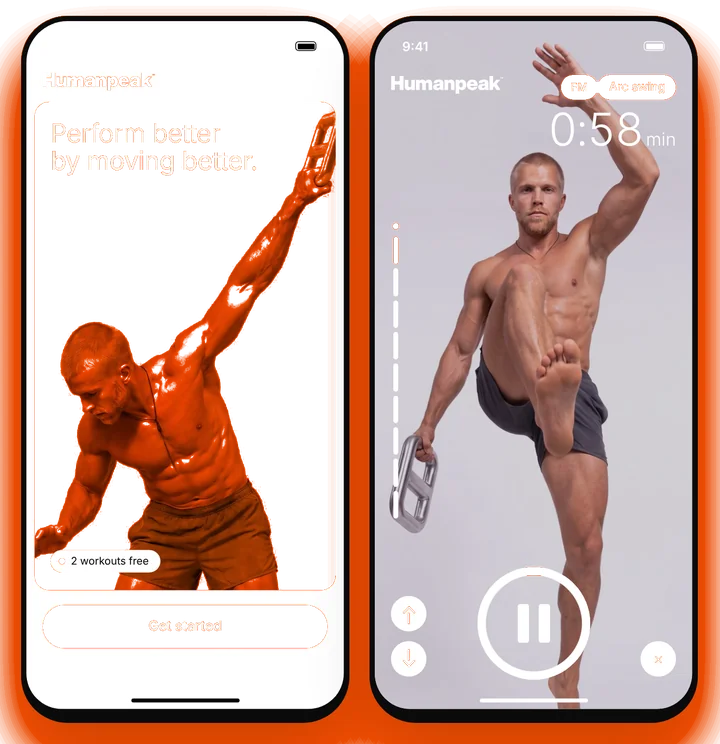
How long does each adaptation take?
Timelines matter, because they explain why the two kinds of training don't compete.
Muscle responds within weeks. Measurable growth after 20 days, with architecture changing even earlier [1]. Neural gains in a trained lift come faster still [2].
Tendon responds more slowly. The meta-analysis only included interventions of at least eight weeks, and effects tended to be larger beyond twelve [4]. The changes were mostly in the material properties of the tendon rather than its size, which means the tissue becomes stiffer before it becomes thicker.
For fascia in the broader sense, evidence is thinner. Robert Schleip and Divo Müller, writing from the fascia research field, described fibroblasts as adapting connective tissue "continually but slowly" and proposed that fascia-oriented training once or twice a week could build a more resilient fascial network over 6 to 24 months [10]. That timeframe is an expert proposal, not a measured result. Their suggested principles are useful for athletes: elastic recoil, preparatory countermovements, dynamic stretching and proprioceptive refinement.
The practical conclusion: you won't trade one adaptation for the other. They run on different clocks. Train the engine continuously, and train the transmission patiently alongside it.
How should athletes combine both?
Keep building the engine. Then train the transmission on purpose.
Lift heavy, and keep doing it. Hypertrophy and heavy strength work build force capacity and the tendon stiffness that transmits it [1][4]. No light tool replaces that, and none should claim to.
Add the fast end. Train movements where a light load is accelerated hard, stopped sharply and redirected. That is where rate of force development and elastic rebound get practiced [7][9].
Add direction. Rotation, diagonals, lateral braking. Force your sport produces outside the sagittal plane has to be practiced outside it.
Respect the clock. Expect muscle and strength changes in weeks, tendon changes over months, and broader connective tissue changes over many months [1][4][10].
- FOCUS: transmission, speed and elastic rebound
- LOAD: light, accelerated hard
- TEMPO: fast reversals, sharp stops
- DIRECTION: rotation, diagonals, lateral
- ALONGSIDE: your heavy strength work
How Humanpeak trains this
You've built strength. Now make it transfer. That is the job Humanpeak was built for, and it starts from respect for the work you've already done in the gym. The 12-Week Movement Protocol runs five workouts per week, about 20 minutes each, across three phases: Restore, Build and Perform. Over 450 movement flows. Every flow combines mobility, control and targeted fascial loading through multidirectional movement to train your body as one connected system. It is designed to sit next to your lifting, not to replace it.
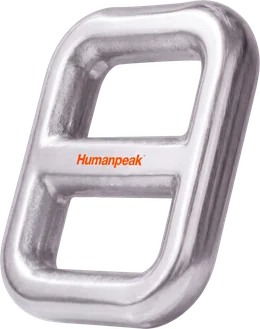
The Humanpeak™ Movement Tool is light by design: 2.2 kg, aluminum, cast in one piece. Light tool. Real force. Force = mass × acceleration, so a light tool accelerated hard and stopped abruptly creates sharp force peaks relative to its weight, at speeds a heavy load never allows. Its offset mass creates torque that changes direction mid-movement, so every stop and reversal asks your whole chain to absorb, redirect and return force, and the feedback principle tells you in the same rep when that chain isn't organized. What it is not: a replacement for heavy strength work, and not a tool for muscle mass or for building tendon stiffness. Heavy load builds how much force you can create. The Movement Tool trains how fast you can create it, plus elasticity, control and force transfer. The principles behind the Humanpeak method are established training science. Studies on the specific tool are still to come.
So answer the reel's question directly. Yes, you need to build muscle. It is the engine, and nothing else in your body produces force. And yes, you should train the layer that carries that force, because the engine is only as good as what it is connected to. Build both.
Move better. Perform better.
Fact check
Frequently asked questions
Humanpeak follows clear sourcing guidelines: we rely on peer-reviewed studies, scientific institutions and professional bodies, and aim for primary sources. Spotted an error? Write to us.
This article is for educational purposes only and does not replace medical advice. If you have symptoms, talk to a doctor.


