Does Static Stretching Actually Do Anything?


Hold the position. Count to thirty. Feel the release. Static stretching is the most practiced and least examined habit in movement culture, and the belief underneath it is simple: the muscle is short, so make it longer. That belief is the part the research does not support, which is why the hook has spread across every mobility feed in the last two years.
So is static stretching effective? Yes — for some outcomes, reliably. No — for the outcome most people think they are buying. The honest answer sits between two lazy positions: the old one that says stretching fixes everything, and the new one that says stretching is useless. Neither survives contact with the data. What follows is what is actually measured, at the confidence level the evidence supports.
Static stretching is effective for increasing range of motion — reliably and measurably. What it does not do is permanently lengthen muscle. Gains come mainly from greater tolerance to stretch, plus a small reduction in passive stiffness. Held long right before power work, it can briefly reduce force output.
Is Static Stretching Effective?
Static stretching works. It simply does not work the way the anatomy poster suggests. Across single sessions and multi-week programs, static stretching produces real, measurable increases in joint range of motion [1]. That part is settled. The argument is about mechanism, and mechanism is what decides how you should use it.
A 2025 systematic review and meta-analysis in Sports Medicine pooled the mechanistic studies and found two effects running in parallel. Chronic static stretching reduced overall passive stiffness by a small amount (g = 0.37) and produced a moderate increase in the maximum passive resistive torque a person would tolerate (g = 0.74). Muscle fascicle length did not change [1].
Translated out of statistics: the body did not build longer muscle. It became a little less resistant at end range, and considerably more willing to go there.
What Actually Changes When You Stretch
The reframe goes back to a 2010 paper in Physical Therapy that is still the reference point for this question. Reviewing the available evidence, Weppler and Magnusson concluded that increases in muscle extensibility after a single stretching session, and after short-term programs of three to eight weeks, are explained by modified sensation rather than by structural lengthening — and noted that programs longer than eight weeks had not been evaluated biomechanically [2].
That paper is often flattened into "stretching is all in your head." That is the second lazy take, and the newer mechanistic data does not support it either. Passive stiffness does drop measurably, in both acute and chronic protocols [1]. The precise position is less satisfying than either slogan: two things change, and the sensory one changes more.
- Stretch tolerance. The largest single contributor. The same tissue resistance is simply permitted further into range, and the end-range signal arrives later [1] [2].
- Passive stiffness. A small, genuine reduction in how hard the tissue resists being taken toward end range [1].
- Fascicle length. No measurable change in the pooled data, acutely or chronically [1]. The muscle is not being permanently lengthened.
The practical consequence is easy to miss. If the change is largely in what the body permits rather than in what the tissue is, then the new range is borrowed, not owned. It exists while the sensation stays modified and disappears when it does not. That is why range gained by holding tends to leak away between sessions, and why people describe the same hamstring as tight for a decade despite stretching it the whole time.
This is the same distinction that separates mobility from flexibility. Passive range is what a joint allows when something else moves it. Usable range is what you can enter, control and produce force in. Stretching addresses the first and largely leaves the second alone. Looser. Not longer. Different things.
Does Static Stretching Hurt Performance?
This is where the internet overcorrected. A systematic review by Behm and colleagues reported an average performance decrement of 3.7% after static stretching, compared with a 1.3% improvement after dynamic stretching. The dose mattered more than the method: holds of 60 seconds or longer per muscle group cost 4.6%, while holds under 60 seconds cost 1.1% [3].
Read the second number again. Roughly one percent, from a protocol almost nobody runs in practice — stretching in isolation, immediately before testing, with nothing in between. The same review concluded that stretching performed inside a warm-up that includes subsequent dynamic activity is recommended, with inconsequential effects on later athletic performance [3].
The mechanism is not damage. A brief reduction in stiffness changes how efficiently the elastic system stores and returns energy, and prolonged holds appear to dampen neural drive for a short window. Both recover quickly. The effect is a temporary shift in the settings, not a cost carried into the session.
- HOLD: UNDER 60 S
- PLACE: EARLY IN WARM-UP
- FOLLOW WITH: DYNAMIC WORK
So the practical rule is a matter of sequencing, not prohibition. If you are about to sprint, jump or lift heavy, do not finish your preparation with long passive holds. Open the position, then load it, then move it fast. The last thing the nervous system rehearses is the thing it will do.
A science-based protocol built around fascial lines to support multidirectional movement.
Start the protocol 14-day money-back guarantee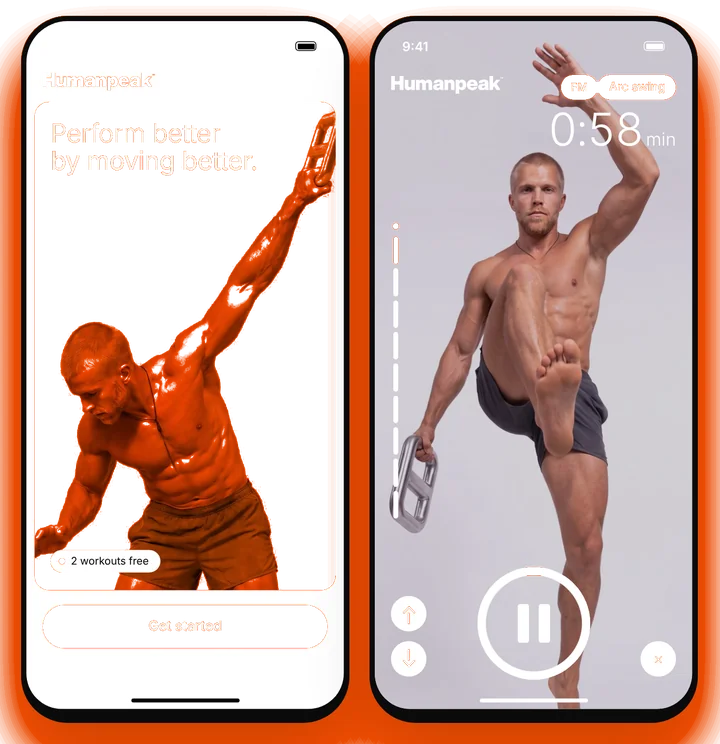
Injury and Soreness: What Stretching Does Not Do
Two claims have carried stretching culture for forty years, and both have been tested properly. Neither held.
On injury: a meta-analysis of 25 randomized controlled trials covering 26,610 participants and 3,464 injuries found no protective effect for stretching (RR 0.963, 95% CI 0.846–1.095). In the same analysis, strength training reduced sports injuries to less than a third of the control rate (RR 0.315, 95% CI 0.207–0.480), and proprioceptive training also showed a clear effect (RR 0.550) [4]. The Behm review reached a compatible conclusion: no clear effect of static stretching on all-cause or overuse injuries [3].
On soreness: a Cochrane review of 12 randomized trials found that stretching before, after, or both before and after exercise produced reductions in muscle soreness of roughly half a point to one point on a 100-point scale. The authors described the effect as not clinically important [5].
This is the honest cost of the ritual. Thirty minutes a week spent on holds is thirty minutes not spent on the input that actually moves injury risk. The method is the target here, never the person practicing it.
When Static Stretching Is Worth Doing
Dropping it entirely is the other error. Static stretching is cheap, low-skill, requires no equipment and reliably delivers the one thing it is good at. There are clear cases where that is exactly what is needed.
- You need range for a specific position — a deeper squat, an overhead reach — and the restriction is tolerance rather than control.
- After a session, when the goal is to return calmly to full length rather than to produce force.
- After long static hours, where the stiffness you feel is not the same as tightness and short holds restore comfortable end range.
- As an entry habit, for anyone who currently trains nothing at all — the first structured minutes are the ones that count.
There is one more finding worth stating precisely, because it is being oversold. A 2024 meta-analysis of 42 studies found that chronic stretching produced small but significant effects on maximal strength (d = 0.30) and muscle size (d = 0.20), with longer durations and higher frequencies driving the effect [7]. Small is the operative word, and the protocols involved stretch volumes far beyond anything a normal practice contains. Stretching is not a substitute for training. The authors position it as an alternative when resistance training is unavailable, not as an upgrade.
One caution belongs here. If a position produces sharp or unfamiliar sensation, or if a joint has recently been irritated, holding harder is the wrong response — stretch intensity is a variable, not a virtue. Persistent restriction that does not respond over weeks is a question for a physician or a qualified therapist, not for a longer hold.
What Trains Range You Can Actually Use
The comparison that reframes the whole question: a meta-analysis of 11 randomized controlled trials with 452 participants found no difference between strength training and stretching for improving range of motion (ES −0.22, 95% CI −0.55 to 0.12) [6].
Both work. Only one of them also builds the capacity to hold, control and produce force in the range it opens — and only one of them shows a protective association with injury [4]. That asymmetry is the argument. If two inputs deliver the same range and one delivers strength alongside it, the choice makes itself.
| Static stretching | Loaded full-range movement | |
|---|---|---|
| Passive range | Improves | Improves |
| Strength in that range | Minimal | Direct |
| Injury risk | No clear effect | Substantial reduction shown for strength training [4] |
| Motor control | Little | Trained by design |
The distinction matters more with age, not less. Passive range can stay respectable while the capacity to control it quietly narrows, and it is the controlled portion that decides whether a position is available under speed, load or fatigue. Training the end range under tension is what keeps those two numbers from drifting apart. Controlled. Loaded. Connected.
This is the principle Humanpeak is built on: usable range is usable strength. Active work takes a joint to end range under control, holds force there, and then moves through it in rotation and diagonal patterns — the body strengthens and coordinates in parallel. The same logic separates rolling from moving: passive input changes sensation, active input changes capacity.
The 12-Week Movement Protocol runs that principle in 5 workouts per week, about 20 minutes each, and the practical frequency question is answered in our guide on how often to train mobility. It sits on top of the training you already do, as the missing layer, not in place of it. Just the range you can use.
Static stretching is not a fraud and it is not a fix. It reliably increases range of motion, mostly by changing what the nervous system tolerates and slightly by reducing passive stiffness. It does not lengthen muscle, does not meaningfully reduce injuries, and does not meaningfully reduce soreness. Used briefly, placed early in a warm-up, aimed at a position you actually need, it earns its minutes.
The upgrade is not to stretch harder. It is to load the range you are asking for. Controlled. Full-body. Repeated.
Fact check
Frequently asked questions
Humanpeak follows clear sourcing guidelines: we rely on peer-reviewed studies, scientific institutions and professional bodies, and aim for primary sources. Spotted an error? Write to us.
This article is for educational purposes only and does not replace medical advice. If you have symptoms, talk to a doctor.


