Your Rib Cage Is Part of the Transmission: Breathing, Thoracic Rotation and Force Transfer


Watch a pitcher, a tennis player or a fighter just before the action. The ribs widen, the trunk loads, and then the whole upper body turns through. Breathing and rotation look like two separate things. In the body, they share the same structures: the same diaphragm, the same rib cage, the same wall of trunk muscle and connective tissue.
A set of reels on this topic keeps resurfacing with three claims. Your diaphragm needs mobile ribs, with 360-degree expansion. Hyperventilating before you perform lowers CO₂ and makes oxygen delivery worse. And chest breathing equals stress. All three point at something real. None of them is the whole story, and the whole story is more useful for an athlete than any of the three lines on its own.
Here is what the research says about your ribs, your diaphragm and your rotation, and how breathing and force transfer depend on each other.
Your rib cage has two jobs that compete for the same structures: expand for breathing and hold firm so rotation can transfer force from your hips to your arms. The diaphragm handles both at once, contracting before fast limb movements and raising abdominal pressure that stiffens the spine, while still breathing. Rib mobility matters because rotation through the upper back moves the ribs too. Breathing patterns are context-dependent: overbreathing has real costs, but "chest breathing equals stress" oversimplifies how the respiratory muscles work under load.
Does your diaphragm really need mobile ribs?
The diaphragm is a dome of muscle that attaches to the lower ribs, the sternum and the lumbar spine. When it contracts, the dome flattens and moves down. That is the core of every breath.
But it does not expand your rib cage on its own. De Troyer and Boriek, in their review of respiratory muscle mechanics, describe what happens when the diaphragm's fibers are activated in isolation: the dome descends, pressure in the chest falls, pressure in the abdomen rises, the belly wall moves out, and a large fraction of the rib cage is actually pulled inward [1]. Expanding the rib cage during inspiration is the work of other muscles: the external intercostals, the parasternal intercostals and, in humans, the scalenes. By lifting the ribs, they help the diaphragm expand the chest and also let it generate more pressure [1].
Aliverti describes the same system in functional terms. Contraction of the diaphragm expands the abdomen and the lower part of the rib cage, the part the diaphragm lies against. The rib cage muscles act mostly on the upper part. The abdominal muscles act on the abdomen and lower ribs. When one group works alone, parts of the chest wall move the wrong way. A smooth breath needs all of them coordinated [2].
So the reel is right that the diaphragm and the ribs belong together. And the reel's "360-degree expansion" is a fair coaching image: the diaphragm attaches all around the lower rib cage and expands it when it contracts, so a well-coordinated breath widens the lower ribs, not only the belly or the upper chest [2]. What the image leaves out is that this is not the diaphragm's achievement alone. It is a team effort between diaphragm, rib cage muscles and abdominal wall, and each of those muscles also has a job in moving and holding your trunk.
Why is your diaphragm also a trunk muscle?
This is the part the reels miss, and for athletes it is the most important one.
Hodges and colleagues asked standing subjects to raise an arm as fast as possible in response to a light. They recorded diaphragm activity with fine-wire electrodes and measured pressures in the chest and abdomen. The diaphragm fired about 20 ms before the shoulder muscle, together with the deepest abdominal muscle, transversus abdominis. It did so regardless of whether the subject was breathing in or out at the time. Abdominal pressure rose by about 14 cmH₂O, and the rise began 63 ms before the arm even started to move [3]. The authors called it definitive evidence that the diaphragm is involved in postural control during fast limb movement.
Then they made the task harder. Hodges and Gandevia had subjects move an arm repetitively, as fast as possible, at around 2.9 movements per second. At rest, the diaphragm relaxes between breaths. During the arm movement, it stayed active through expiration, at 78% of its peak inspiratory activity. Its signal carried two rhythms at once: one at the breathing rate, about 0.4 Hz, and one at the arm movement rate. The faster the arm accelerated, the more the diaphragm worked [4].
What does that tonic activity buy you? Pressure. Hodges and colleagues stimulated the phrenic nerves of three subjects to make the diaphragm contract without the abdominal and back muscles joining in. Abdominal pressure rose, and the stiffness of the lumbar spine rose with it, by 8 to 31% of resting levels. The bigger the pressure increase, the stiffer the spine [5]. Three subjects is a tiny sample, so treat the numbers as a demonstration of principle. The principle is clear: a pressurized abdomen is a stiffer base.
The practical meaning: in sport, you never get to choose between breathing and bracing. A fighter has to breathe between strikes and brace on every one. A tennis player has to find air somewhere between the split step and the next swing. The athletes who look relaxed under pressure are often the ones whose diaphragm can do both jobs without one strangling the other.
What do your ribs have to do with rotation?
Rotate your upper back and you are not only turning vertebrae. Each thoracic vertebra connects to a pair of ribs, and the ribs connect to the sternum in front. The thoracic spine and the rib cage move as one structure.
Watkins and colleagues tested ten human cadaveric thoracic spines with the rib cage intact, then with the sternum fractured, then with the rib cage removed. The intact rib cage increased the stability of the thoracic spine by 40% in flexion and extension, 35% in side bending and 31% in axial rotation [6]. These are cadaver specimens without active muscle, so the numbers describe passive mechanics, not a living athlete. But they make the anatomy clear: the rib cage is not a passenger on the spine. It shares the load of rotation and holds the upper back together when it turns.
That cuts both ways for an athlete. A rib cage that can open and close on each side lets the thorax rotate and side bend. A rib cage that is held rigid, or stuck in a fully inflated position, limits how far and how freely the upper back can turn. Breathing and thoracic rotation share the same joints, and when you load one, you change what is available for the other. That link is an anatomical inference, not something the cadaver study measured in motion.
Why does that matter for performance? Because rotation is how force gets from the ground to the hand. Aguinaldo and colleagues analyzed the throwing motion of 38 pitchers across different levels. Among mature players, professionals generated the lowest rotational torque at the shoulder, while rotating their trunk significantly later in the pitch [7]. The authors concluded that the timing of trunk rotation lets the shoulder ride momentum generated by the trunk, with less load on the joint. That is force transfer: the trunk does the work, the arm delivers it.
And the trunk is not only muscle. Across it run long connective tissue lines, first described as myofascial meridians by Tom Myers in Anatomy Trains. Wilke and colleagues reviewed 62 anatomical dissection studies and found strong evidence for the continuity of the Back Functional Line, which links the latissimus dorsi through the thoracolumbar fascia to the opposite gluteus maximus, and the Front Functional Line, which runs diagonally across the front of the trunk [8]. These diagonal lines connect one shoulder to the opposite hip, exactly the geometry of a throw or a swing. The dissection evidence shows the connection. How much force travels along it in a living athlete is still being studied, as the authors themselves note [8]. For more on the back one, see the posterior oblique sling and the thoracolumbar fascia.
- FOCUS: hips lead, ribs follow, arm delivers
- LOAD: light enough to rotate fast
- TEMPO: breathe through the turn, brace on the release
Does hyperventilating before a sprint hurt your performance?
The second reel claim is about chemistry. Breathe too fast and too deep, and you blow off CO₂. With less CO₂, oxygen gets stuck in the blood instead of reaching your muscles. That is the claim. Here is how much of it holds.
The mechanism is real. It is called the Bohr effect: hemoglobin's affinity for oxygen falls when CO₂ rises or blood pH drops, and that lower affinity helps oxygen unload in working tissue [9]. Run the effect in reverse, by lowering CO₂ through overbreathing, and hemoglobin holds on to oxygen more tightly. A second effect is easier to feel. Low CO₂ constricts the blood vessels of the brain. In their review, Willie and colleagues report that cerebral blood flow falls by roughly 1 to 3% for every mmHg that CO₂ drops below normal [10]. It is part of why athletes feel light-headed when they over-breathe before a big moment.
So far the reel is right. But there is a twist the research adds. Sakamoto, Naito and Chow tested 13 male athletes in ten 10-second maximal cycling sprints with 60 seconds of recovery between them. In one condition, the athletes breathed normally. In the other, they hyperventilated for 30 seconds before each sprint, at 60 breaths per minute, with CO₂ held in a fixed low range. Blood pH rose slightly. Overall peak and mean power were not different between conditions, but the drop in power across the later sprints was smaller with hyperventilation [11]. The authors explain it as respiratory alkalosis partly offsetting the acid build-up of repeated maximal efforts.
That does not make hyperventilation a performance hack. It was a tightly controlled protocol in one type of effort, with CO₂ monitored throughout. It also does not contradict the Bohr effect. Repeated 10-second sprints place heavy anaerobic demands on the muscle, and the acid they produce is what the alkalosis appears to buffer [11]. Oxygen unloading is a different problem from that one. What it shows is that the reel's claim, "hyperventilation worsens performance," is too broad. The physiology depends on what the effort demands.
| WHAT THE CLAIM SAYS | WHAT THE RESEARCH SHOWS |
|---|---|
| The diaphragm needs mobile ribs | Accurate with nuance: the diaphragm expands the lower ribs and abdomen; rib cage muscles expand the rest, in coordination [1, 2] |
| Breathing is about oxygen | Incomplete: the diaphragm also contracts before fast limb movement and raises abdominal pressure that stiffens the spine [3, 4, 5] |
| Hyperventilation worsens oxygen delivery | Accurate in mechanism: low CO₂ increases hemoglobin's oxygen affinity and reduces brain blood flow [9, 10] |
| Hyperventilation always hurts performance | Not supported: in one repeated-sprint study, it reduced the decline in power across later sprints [11] |
| Chest breathing equals stress | Oversimplified: rib cage muscles are normally recruited during exercise; breathing pace, not rib cage motion, is the lever with the clearest evidence [2, 12] |
A science-based protocol built around fascial lines to support multidirectional movement.
Start the protocol 14-day money-back guarantee
Is chest breathing a stress response?
The third claim is the most popular and the least precise.
During heavy exercise, rib cage breathing is not a sign of anything wrong. Aliverti explains that as ventilation increases, the diaphragm works mainly as a flow generator, while the rib cage and abdominal muscles act as pressure generators. The expiratory muscles, quiet at rest, become active. Rib cage muscles and abdominals work in an alternating rhythm that prevents rib cage distortion and lets the diaphragm work near its optimal length [2]. In other words, a sprinting athlete breathing hard through the chest is breathing correctly. That pattern is the system working at capacity.
What does have a clear link to your nervous system is breathing pace. Laborde and colleagues pooled 223 studies on voluntary slow breathing and found that it increases vagally mediated heart rate variability during the breathing, immediately after a session and after multi-session interventions [12]. Heart rate variability of this kind is a marker of parasympathetic activity, the "rest and recover" branch. That gives athletes a practical lever before a competition, between rounds or after training: slow the breath down, and the body follows.
So where does "chest breathing equals stress" come from? Probably from a real observation stretched too far. Under stress, many people breathe faster and higher in the chest. But the arrow runs from state to pattern, and the research reviewed here does not show that rib cage breathing itself creates stress. The honest version is shorter: breathing pattern is context-dependent. Breathe hard when the work demands it. Breathe slow when you want to come down.
How do you train breathing, ribs and rotation together?
None of this calls for a separate breathing program. It calls for training the trunk the way your sport uses it: breathing, bracing and rotating at the same time.
Rotate with your ribs, not around them. In rotational drills, let the rib cage turn with the thoracic spine, open on one side and close on the other. The rib cage is part of the structure that rotates [6], so holding it rigid works against the turn.
Breathe through the movement. If you can only rotate while holding your breath, your trunk control depends on one strategy. Fast arm movements in research came with continued breathing on top of postural diaphragm activity [4]. Practice rotations where you keep breathing, and brace sharply only on the release or the impact.
Let the hips lead. The professional pitchers in Aguinaldo's analysis rotated the trunk later and loaded the shoulder less [7]. Sequencing is a skill. Train it under light load, at speed, from different stances.
Train every direction. The diagonal lines across the trunk run both ways [8]. Your sport rotates left and right, high and low, forward and back. Your training should too.
Use slow breathing as a tool, not a doctrine. Before competition or between efforts, slow breathing is a well-supported way to shift your state [12]. During maximal efforts, let breathing do what the work demands [2].
How Humanpeak trains this
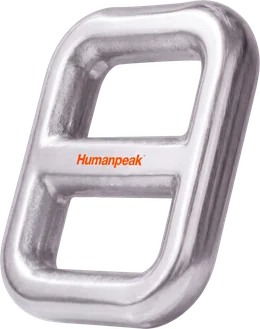
Humanpeak is not a breathing program. It trains the structures breathing shares with rotation: the trunk that has to breathe, brace and turn at once. Rotation under load is central to the Humanpeak method. The Humanpeak™ Movement Tool weighs 2.2 kg, cast in one piece from aluminum, with its mass sitting outside your grip. In the Butterfly Grip, both hands hold the frame, your arms connect and your trunk drives. As the tool accelerates and stops, the offset mass creates torque that changes direction mid-movement, so your rib cage and thoracic spine have to turn, hold and turn back in every direction, not only left and right in one plane. Force has to pass from your stance through your trunk to the tool, rep after rep, with load that never arrives from the same angle twice.
That is rotation under load as a skill: hips leading, trunk transferring, ribs moving with the turn, breath continuing through it. The 12-Week Movement Protocol builds this in three phases, Restore, Build and Perform, with 5 workouts per week of about 20 minutes each and over 450 movement flows. Every flow combines mobility, control and targeted fascial loading through multidirectional movement. For the bigger picture of how force travels through the trunk, see power without more muscle. The principles behind Humanpeak are established training science. Studies on the specific tool are still to come.
Your rib cage is not a cage. It is part of the transmission between your hips and your hands. Let it move when you breathe. Let it hold when you turn.
Move better. Perform better.
Fact check
Frequently asked questions
Humanpeak follows clear sourcing guidelines: we rely on peer-reviewed studies, scientific institutions and professional bodies, and aim for primary sources. Spotted an error? Write to us.
This article is for educational purposes only and does not replace medical advice. If you have symptoms, talk to a doctor.


