Bone Responds to Load: What Exercise for Bone Density Actually Requires


Exercise for bone density is one of the few areas of training where the biology is unusually specific. Bone does not respond to effort, sweat or intention. It responds to mechanical signals: how large the load is, how quickly it arrives, from which direction, at which site, and how often it is repeated over years [1]. Most other training variables are negotiable. These are not.
That specificity is why the most repeated advice online — lift heavy — is correct but incomplete. Heavy load is one input among several, and in the human data it is not always the one doing the work. This guide separates what is established from what is inferred, names the sites where the effect shows up, and states plainly where the honest limits sit.
Exercise for bone density works when load is dynamic, high in magnitude or speed, applied at the site you want to change, and repeated for months to years. In trials, progressive resistance training at roughly 70 percent of one-rep max combined with impact loading improved hip and spine density, while walking alone generally did not.
What Kind of Exercise for Bone Density Actually Works?
Across trials and consensus statements, four conditions keep reappearing. Load has to be dynamic. It has to be large or fast enough to exceed what the skeleton already meets in daily life. It has to be applied through the site you want to change. And it has to keep happening [1][6]. A program that satisfies three of the four tends to produce nothing measurable.
- SIGNAL: DYNAMIC LOAD
- QUALITY: MAGNITUDE + RATE
- SITE: WHERE IT IS APPLIED
- HORIZON: MONTHS TO YEARS
- Magnitude. Progressive resistance training at or above roughly 70 percent of one-rep max produced the clearest density effects at the femoral neck and total hip in a 2025 meta-analysis of 17 randomized trials [4].
- Rate. Impact loading adds speed of force application, which in controlled loading models is an independent driver of the adaptive response [1].
- Site. Bone changes where it is loaded. A meta-analysis of 28 impact-training trials found improvement in proximal femur volumetric density and distal tibia trabecular density, with no overall effect at the lumbar spine or distal radius [3].
- Time. Interventions shorter than about a year rarely move the hip. Trials of 48 weeks and longer were the ones showing femoral neck effects [4].
The practical reading is unglamorous. Bone is a slow, local, conservative tissue. It answers the question it was asked, in the place it was asked, and only if the question is repeated.
What Bone Actually Reads: Four Rules From the Loading Studies
The mechanical rules were mapped in controlled animal loading models long before they appeared in gym advice. A review of that work by Meakin, Price and Lanyon sets out the pattern with unusual clarity [1].
- Dynamic beats static. In the classic avian model, a static load applied continuously produced a 13 percent loss of bone mass. The same load applied dynamically for a single 100-second period per day produced a 24 percent gain.
- Rate is its own signal. A fivefold increase in strain rate increased bone formation in both amount and extent — the same peak load, delivered faster, is read as a stronger message.
- The response saturates early. As few as four loading cycles a day were enough to prevent disuse-related bone loss, with little additional benefit from thousands more cycles.
- Rest inside the set matters. Inserting a short pause between loading cycles substantially enhanced the formation response compared with the same cycles delivered back to back.
The honest limitation: these are animal loading models with controlled strain, and the exact numbers do not transfer one-to-one to a human hip. What transfers is the shape of the relationship. Short. Fast. Varied. Repeated.
Heavy, Fast, or Both? What the Human Trials Show
The most cited human trial in this field is LIFTMOR. One hundred and one postmenopausal women, average age 65, with low bone mass, were randomized to eight months of supervised high-intensity resistance and impact training — twice weekly, 30 minutes a session [2].
| Outcome (8 months) | Training group | Control group |
|---|---|---|
| Lumbar spine density | +2.9% | -1.2% |
| Femoral neck density | +0.3% | -1.9% |
| Femoral neck cortical thickness | +13.6% | +6.3% |
| Session compliance | 92% | 85% |
Two details deserve more attention than the headline. First, the control group lost density over the same eight months, so a large part of the between-group difference is loss prevented rather than density added. Second, the intervention was supervised, progressive and reported only one minor adverse event across the trial [2]. Intensity was possible because coaching was present.
The dose question was addressed directly in a 2025 meta-analysis of 17 randomized trials in postmenopausal women: intensity at or above 70 percent of one-rep max, three sessions per week, and programs running 48 weeks or longer were the parameters associated with density gains at the femoral neck and total hip [4]. Impact training reviewed separately across 28 trials moved proximal femur and distal tibia measures but not the lumbar spine [3]. Different tools, different addresses.
Built around fascial lines. 20 minutes per session, 5 times a week, guided step by step in the app.
Start the protocol 14-day money-back guarantee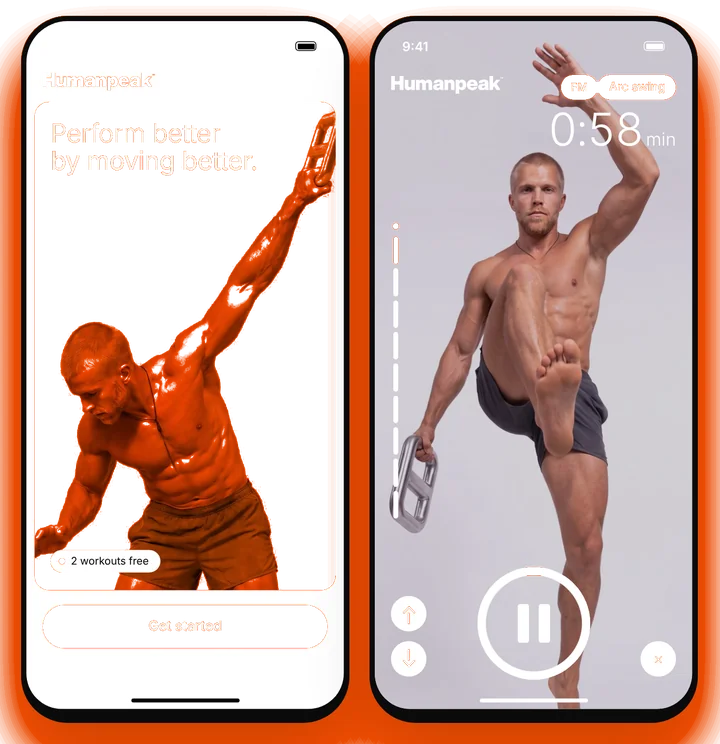
Why Walking Is Not a Bone Program
Walking is excellent for almost everything else. As a bone stimulus it is close to invisible, because the skeleton is already fully familiar with it. The UK consensus statement on physical activity and osteoporosis makes the point carefully: general aerobic recommendations may not include exercise with sufficient gravitational loading to increase bone strength [6].
The athlete data point the same way. In a systematic review of loading types, athletes in high-impact sports carried roughly 60 percent greater cortical thickness at the inferior femoral neck than controls, and athletes in odd-impact sports — the ones full of cutting, turning and unpredictable direction changes, such as soccer and racket sports — showed about 20 percent thicker cortex distributed uniformly around the neck. Repetitive low-impact loading such as distance running showed no such cortical advantage [5].
That contrast is the strongest argument in this article for training direction rather than only training weight. Uniform reinforcement around a bone comes from load arriving from many angles. It is also the weakest form of evidence here: these are cross-sectional comparisons of athletes, which show association and cannot prove that the sport built the bone rather than the bone selecting the athlete.
For anyone whose training is a straight line — press, squat, run, repeat — the useful next step is not more weight but more angles. That is the same argument made in rotation training and in why a light tool can produce real force.
The Variable That Outranks Heavy: Repetition Across Years
Here is the part that rarely makes the viral version. The consensus guidance for people without vertebral fracture asks for moderate impact on most days of the week, with at least 50 impacts per session, plus muscle-strengthening work on two or three days [6]. Not one heroic session. A weekly pattern that repeats for decades.
And the pattern has to hold. A 2025 systematic review of detraining in postmenopausal osteopenia and osteoporosis concluded that density improvements are at risk once structured training stops, and that continuous physical activity is what preserves them [8]. Bone is not a bank account. It is a subscription.
This is where program design decides outcomes more than exercise selection does. The heaviest plan you cannot sustain through a work year loses to the moderate plan that survives it. Consistency beats intensity — not as a slogan, but as the only way the 48-week threshold in the resistance-training data ever gets reached [4].
Humanpeak is built for that half of the equation: 5 workouts per week, about 20 minutes each, multiplanar, with the Humanpeak Movement Tool (2.2 kg), trained as a repeating practice rather than an event. The body builds coordination and elastic quality while the week stays intact. Where bone loading is the goal, the 12-Week Movement Protocol is a layer on top of progressive resistance work, not a replacement for it. Related reading: what actually changes in training after 40 and how long until your body adapts.
Bone Density Is Not the Whole Fracture Story
Density is a proxy. The event that breaks a hip is almost always a fall, and the evidence for changing that is stronger and faster-acting than the evidence for changing density. A Cochrane review of 108 randomized trials and 23,407 community-dwelling older adults found exercise reduced the rate of falls by about 23 percent. Balance and functional training accounted for a 24 percent reduction with high-certainty evidence, and programs combining balance, functional and resistance work reached 34 percent [7].
Read together with the loading literature, the picture is coherent rather than contradictory. Progressive resistance and impact address the material. Balance, reactive control and the ability to produce force quickly address the moment. Both are trainable. Only one of them shows up on a scan.
For everyone else, the mandate is simple to state and slow to execute. Load it. Vary it. Keep it.
The evidence on exercise for bone density is narrower than the internet suggests and more demanding than most programs admit. Dynamic load, applied fast, at the site in question, from more than one direction, repeated for years. Heavy lifting satisfies part of that list. Direction, rate and durability satisfy the rest, and they are the parts most training plans quietly skip.
Build the load. Train the angles. Keep the practice.
Fact check
Frequently asked questions
Humanpeak follows clear sourcing guidelines: we rely on peer-reviewed studies, scientific institutions and professional bodies, and aim for primary sources. Spotted an error? Write to us.
This article is for educational purposes only and does not replace medical advice. If you have symptoms, talk to a doctor.


