Knee Pain Usually Starts Above and Below the Knee


Knee pain, hip and ankle mobility are usually treated as three separate subjects. The knee is where it hurts, so the knee is where the attention goes: a brace, ice, a scan, a set of leg extensions. Meanwhile the joint above and the joint below carry on doing whatever they were doing. That is the part worth examining, because the knee is a hinge sitting between two joints built to rotate, and what those two joints can and cannot do shapes a large part of what the knee has to absorb [1][2].
The framing here is the joint-by-joint model, popularized in coaching by Gray Cook and Michael Boyle. It is reasoning, not a law of the body: the ankle is asked for range, the knee for stability, the hip for range and control at once. Where range or control goes missing above or below, the knee tends to pick up the difference. Research supports parts of that model and complicates other parts. Both halves belong in the same article.
Knee pain, hip and ankle mobility are linked because the knee is a hinge between two rotating joints. Restricted ankle dorsiflexion and poor hip control both shift the knee inward and change how load is distributed. Studies show combining hip-focused and knee-focused exercise reduces knee pain better than knee work alone.
Why the Knee Is the Site and Rarely the Source
The knee is built for one main job: flexion and extension, with a small amount of rotation available near the end of range. The hip above it is a ball and socket that moves in three planes. The ankle and the joints under it below allow dorsiflexion plus a coupled rotation of the foot. So the leg alternates: a mobile joint, a stable joint, a mobile joint.
Nothing in that arrangement is fragile. It becomes a problem only when a movement demands more range than the hip or ankle can deliver. The demand does not disappear. It gets redistributed, and the joint with the least room to absorb it is the one in the middle.
That inward drift has a name in the literature: dynamic knee valgus, or medial knee displacement. It is not a character flaw and not a diagnosis. It is a description of what a leg does when the demands of a squat, a step-down or a landing exceed what the joints above and below are currently offering.
How Do Hip and Ankle Mobility Affect Knee Pain?
Start below. A systematic review and meta-analysis pooling studies on ankle dorsiflexion found that people who show dynamic knee valgus have less available dorsiflexion than those who do not, with a standardized mean difference of -0.65 (95% CI -0.88 to -0.41). The association was strongest when dorsiflexion was measured in a weight-bearing position, which is also the position the knee actually works in — SMD -1.25 [1].
That is a correlation. The more interesting study removed the ambiguity by restricting the ankle on purpose. Placing healthy participants on a 12-degree wedge to block dorsiflexion produced, within the same session, less peak knee flexion, less knee-flexion excursion, a greater peak knee-valgus angle and a large increase in medial knee displacement. Vastus lateralis and vastus medialis activity dropped while soleus activity rose [2]. Take range away at the ankle and the knee mechanics change immediately.
Now above. A prospective study following female runners found that those who went on to develop anterior knee pain had already shown greater hip adduction at baseline — the thigh falling toward the midline during stance. Hip internal rotation angle did not distinguish the groups [3]. The signal was not how the hip was shaped or how much range it had. It was what the hip did while it was loaded.
| JOINT | WHAT IT IS ASKED FOR | WHAT THE KNEE ABSORBS WHEN IT IS MISSING |
|---|---|---|
| Ankle | Forward travel over the foot under load | Less knee flexion, more inward drift, more work through the front of the knee [1][2] |
| Hip | Range plus control in three planes | Thigh collapsing toward the midline, rotation transferred down the chain [3] |
| Knee | Stability through a long hinge range | Repeated exposure to motion it is not built to steer |
Read together, the two ends of the chain tell one story: the knee is the reporting joint. It reports on the quality of what happens above and below it.
What the Hip Evidence Really Shows
Here is where the popular version of this idea overreaches, and where being accurate is more useful than being persuasive. The line "weak hips cause knee pain" is repeated constantly. The prospective evidence does not support it.
A systematic review and meta-analysis in the British Journal of Sports Medicine found moderate-to-strong evidence from prospective studies of no association between isometric hip strength and the risk of developing pain at the front of the knee. Cross-sectional studies do show that adults who already have that pain are weaker at the hip than controls without symptoms. The authors' reading: reduced hip strength is more plausibly a consequence than a cause [4].
A more recent meta-analysis following military recruits reached a compatible conclusion. Quadriceps weakness showed moderate evidence as a prospective risk factor, while age, height, weight, body mass index, body fat and Q angle did not predict who developed knee pain — and hip weakness did not emerge as a predictor either [5].
- Association is not direction. Measuring a weak hip in someone who already hurts does not tell you which came first.
- Static strength is not the same variable as loaded control. Isometric hip strength failed to predict onset, while hip adduction during running did [3][4].
- The knee still matters. Quadriceps capacity carries prospective evidence in its own right [5]. Training above and below is an addition, not a replacement.
So the honest version of the viral claim is narrower and, we would argue, more interesting. The knee is rarely the whole problem. That does not make the hip the culprit either. What travels through the chain is load and motion, and both are shaped by control.
A science-based protocol built around fascial lines to support multidirectional movement.
Start the protocol 14-day money-back guarantee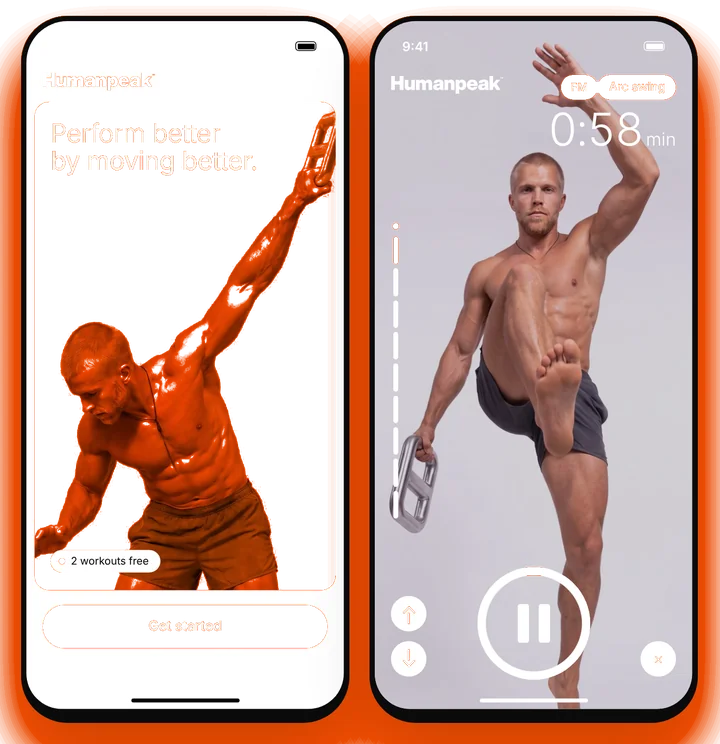
Control, Not Just Strength: What Actually Changed in the Trials
If hip weakness does not cause knee pain, an obvious question follows: why does training the hip help anyway? Because it does. A meta-analysis of 14 randomized controlled trials with 673 participants found that combined hip and knee strengthening beat knee strengthening alone for reducing pain (mean difference -1.5; 95% CI -2.3 to -0.8) and improving activity (SMD 0.7; 95% CI 0.2 to 1.3) [6].
The most defensible reading is coordination and load distribution: where the leg goes under load, how motion is shared between joints, how quickly the hip organizes itself when the foot hits the ground. That is a motor-control quality. It is trainable at any age, and it does not require any claim about remodeling tissue.
The 2018 international consensus statement on patellofemoral pain lands in the same place, recommending exercise therapy and specifically the combination of hip-focused and knee-focused exercise, while advising against isolated passive interventions such as knee or lumbar mobilizations on their own [7]. A randomized trial testing that idea directly compared hip strengthening plus trunk and lower-limb movement control against a conventional quadriceps-only program, and found less pain at three-month follow-up in the group that trained control alongside strength [8].
- FOCUS: CHAIN CONTROL
- PLANES: ALL THREE
- TARGET: HIP
- KNEE
- ANKLE
Passive input does not produce that. Being rolled, pressed or stretched can change how a joint feels for a while. It does not teach the leg a new way to organize itself under load. New movement patterns do.
How to Train the Chain Above and Below the Knee
The practical version is unglamorous and repeatable. Five priorities, in the order they tend to pay off.
- Restore weight-bearing ankle range, not just seated stretch range — the loaded position is where the association with knee mechanics is strongest [1].
- Train the hip in three planes, including rotation, rather than only forward and back.
- Load the knee through its range under control: slow step-downs, split positions, tempo work, full depth where it is available.
- Add rotation and single-leg work, because stance in walking, running and sport is one leg at a time.
- Keep it frequent and short. Motor control responds to frequency more than to occasional volume.
This is exactly the layer that most training programs skip. Linear, isolated, sagittal work builds capacity in one plane and leaves the leg unrehearsed in the others. The Humanpeak 12-Week Movement Protocol is built the other way around: full-body flows with the Humanpeak™ Movement Tool (2.2 kg) that load hip, knee and ankle in sequence, in rotation, in 5 workouts per week of about 20 minutes each, across three phases: Restore, Build and Perform.
- No isolation-only plan. Leg extensions build the quadriceps. They do not teach the hip what to do at foot strike.
- No passive substitute. Massage and rolling belong in recovery, not in the place where movement learning should be.
- No single culprit. Train the chain, then reassess what the knee reports back.
Range you can access. Control you can hold. Load you can repeat.
When the Knee Needs More Than Training
Movement work is for capacity, not for diagnosis. Some presentations belong with a clinician first, and delaying that is not stoicism.
- A clear injury event. A twist, a pop, a fall, immediate swelling, or an inability to bear weight.
- Mechanical symptoms. The knee locking, catching, or giving way underneath you.
- Heat, redness or persistent swelling. Signs that call for an assessment rather than a training plan.
- Pain that keeps escalating. Complaints that intensify week over week despite sensible load management.
Outside of those, the general direction of the evidence is consistent and reassuring: active exercise is the recommended first line for persistent knee complaints, and the combination that includes the hip performs better than the knee on its own [6][7].
The knee is honest. It reports what the rest of the leg is doing, which is why the knee alone is a poor place to spend all of your attention. Give the ankle its range back. Give the hip something to control. Then let the knee do the one job it is built for.
Move the chain, not the symptom. Steady. Connected. Repeatable.
Fact check
Frequently asked questions
Humanpeak follows clear sourcing guidelines: we rely on peer-reviewed studies, scientific institutions and professional bodies, and aim for primary sources. Spotted an error? Write to us.
This article is for educational purposes only and does not replace medical advice. If you have symptoms, talk to a doctor.


