Duck-Footed Walking: What Your Feet Are Telling You


Look down at a red light and the pattern is easy to spot: the feet drift outward, one side usually more than the other. Duck-footed walking, or out-toeing in clinical language, has become one of the most screenshotted gait patterns online, normally attached to a confident promise that it explains your back pain and that an insole will correct it. The duck footed walking causes that actually appear in the research are more layered than that, and considerably more useful.
Some of what points a foot outward is bone, set during growth and unmoved by exercise. Some of it is rotation the hip no longer offers. Some of it is a foot that cannot organize itself against the ground, and some of it is simply the default the body falls back on when nothing else is asked of it. Knowing which is which decides whether training is worth the effort, and what kind of training it should be.
Duck footed walking, or out-toeing, is a gait pattern in which the feet point outward relative to the direction of travel. The main duck footed walking causes are femoral and tibial torsion, limited hip rotation, foot and ankle control, and habit. Bone shape is fixed; rotation and control are trainable.
What Duck-Footed Walking Actually Is
Gait labs describe this with a single number: the foot progression angle, measured between the direction the body is traveling and the long axis of the foot. Toes out reads as positive, toes in as negative. Almost nobody walks at zero, and a modest degree of turnout is ordinary rather than remarkable.
Variation between healthy people is wide. In a study of 102 healthy adults, tibial torsion was significantly higher in the group with a high foot progression angle, and femoral torsion tracked with how much internal rotation the hip made available [1]. More than half of the participants carried offsetting torsions, a thigh bone rotated one way and a shin bone rotated the other, which is exactly why the foot on the floor reports the sum of the leg rather than the state of any single segment [1].
- MEASURE: FOOT PROGRESSION ANGLE
- TYPICAL: MILD TURNOUT
- VARIATION: HIGH
What Causes Duck Footed Walking?
Turnout is the shared output of at least four inputs. They rarely show up alone, and they are not equally trainable — which is the part most content on this topic skips.
- Femoral torsion. The thigh bone can sit rotated outward relative to the knee. This is bone geometry laid down during growth, and it sets a floor under how straight the foot can point without twisting the knee to get there [2].
- Tibial torsion. The shin bone carries its own twist, and it is the segment most closely associated with a high foot progression angle in healthy adults [1].
- Hip rotation availability. When a hip gives external rotation freely and internal rotation reluctantly, walking drifts toward the range that is on offer. Femoral torsion and hip internal rotation are related [1], but rotation is also a soft-tissue and control quality, and that portion responds to training.
- Foot and ankle capacity. A foot that cannot hold its shape, or an ankle that runs out of dorsiflexion, changes what the leg above it does. When dorsiflexion is experimentally restricted, knee kinematics and quadriceps activation change measurably inside the same squat [3]. The body routes around a missing range instead of stopping.
- Habit and strategy. Fatigue, footwear and years of narrow, forward-only training all push toward a wider, more externally rotated base. A turned-out stance is a stability strategy before it is a fault.
Bone or Trainable Pattern? How to Tell
This question decides everything downstream, and the honest answer is that part of the pattern is not negotiable. The American Academy of Orthopaedic Surgeons is direct about the pediatric version: for tibial torsion, splints, special shoes and exercise programs do not help, and for femoral anteversion, special shoes, braces and exercises do not help either [2]. Most rotational patterns in children correct themselves as the skeleton matures [2]. In an adult, whatever torsion is left is simply the shape of the bone.
What sits on top of that bone is a different conversation. Hip rotation range, the strength available at the end of that range, foot control and the walking pattern itself are all trainable capacities. The useful frame is not straight versus crooked. It is how much of this turnout the body can change when it is properly asked.
- Sit tall with the knees bent at ninety degrees and swing the lower legs outward, then inward. Compare sides. A large gap between internal and external rotation means the hip is doing most of the talking.
- Stand and let the feet fall where they fall, then turn each whole leg from the hip until the kneecaps face forward. If the feet come close to straight, the turnout is largely rotation. If the feet still splay while the knees face forward, torsion is contributing.
- Walk twenty steps and watch whether one side turns out more than the other. Asymmetry carries more information than the absolute angle.
- Stand on one leg for thirty seconds. If the pelvis drops or the foot rolls inward, control is part of the picture regardless of bone shape.
None of this is a diagnosis. A clinician can measure rotation properly in a few minutes, and a phone camera cannot. Treat these as orientation, not as a verdict.
A science-based protocol built around fascial lines to support multidirectional movement.
Start the protocol 14-day money-back guarantee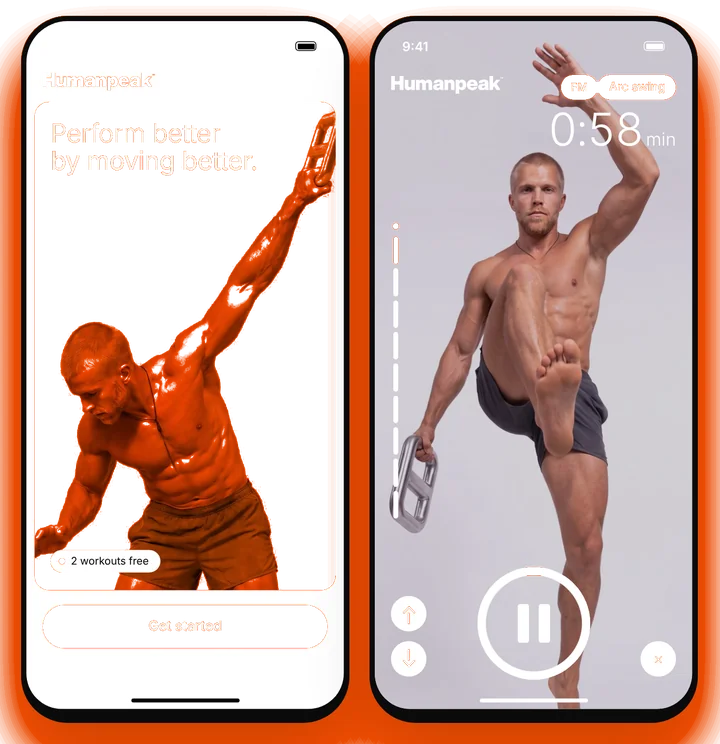
Does Turnout Actually Cause Pain?
Here the viral version overreaches. A 2024 systematic review pooled 13 studies and more than 102,000 participants on lower limb alignment and low back pain. Flat feet showed the strongest association, increased hip internal rotation showed moderate evidence, and hip external rotation and total rotation showed no significant difference between people with and without back pain [4]. The authors state plainly that heterogeneity across study designs prevented a definitive conclusion [4]. Turnout as a proven cause of back trouble is not what that body of work supports.
The knee research is more nuanced again. A meta-analysis of foot progression angle modification found that walking with more toe-out reduced the second peak knee adduction moment in people with medial knee osteoarthritis, while toe-in reduced the first peak in people without it [5]. Turning a foot outward is not an error the body made by accident. It is one way of moving load around, with tradeoffs running in both directions.
Angle is data. Capacity is the answer.
Why an Insole Rarely Changes the Pattern
The most useful evidence compares the two approaches head to head. A systematic review and meta-analysis of 41 studies on conservative interventions for foot progression angle reported that gait training produced mean changes of 6.69° and 16.06°, while mechanical interventions such as insoles and external devices produced 0.44° [6]. The authors concluded that gait feedback training was more effective than external devices for sustained improvement in foot angle, pain and walking performance in that population [6].
That does not make orthoses pointless. A well-chosen device can offload a specific structure, settle a symptom and buy time while capacity is built. What it does not do is teach a leg a new rotation strategy, and in children it does not change torsion at all [2]. A device works under the problem. A pattern lives above it. Orthotics or foot training takes that split apart in detail.
- DEVICE: CHANGES THE SURFACE
- TRAINING: CHANGES THE STRATEGY
- EVIDENCE: FAVORS TRAINING FOR ANGLE
What Actually Changes a Gait Pattern
Three layers, trained in that order, then repeated often enough to count.
- Rotation at the hip. Range the body cannot access is range walking will never use. Active internal rotation work — controlled, loaded, standing as well as seated — is the entry point, and it is the range most adults have quietly surrendered. Lost internal rotation goes further into why.
- Capacity in the foot. A meta-analysis of 16 studies and 627 participants found that intrinsic foot muscle training reduced navicular drop and improved foot posture index scores and dynamic postural balance, while producing no significant change in measured muscle size [7]. Read that honestly: the function moved, the tissue measurements did not. Function is the part walking uses.
- Control under rotation. Standing on one leg while the body turns above it is the situation the foot is genuinely in during gait. Training rotation over a single support leg builds the thing the pattern is missing, rather than the thing that is easy to measure.
Then comes the step almost everyone skips. In a six-month follow-up of a gait retraining trial, runners showed no significant retention of their new pattern when tested without a cue, yet a single verbal reminder to move as they had at the end of the program returned a 32% reduction in peak tibial acceleration [8]. The pattern was stored. It was simply not automatic yet. That gap closes with frequency rather than intensity, which is why the 12-Week Movement Protocol trains rotation, foot control and full-body patterns in 5 workouts per week, about 20 minutes each, instead of twice a week in long sessions.
Measured. Trained. Repeated.
Duck-footed walking is a readout, not a verdict. Part of it is bone that will not move, part of it is rotation the hip stopped offering, and part of it is a foot that has not been asked to control anything demanding in years. The first part deserves acceptance. The other two deserve training.
So stop measuring the angle and start testing the capacity underneath it: rotation available in both directions, an ankle that still reaches, a foot that holds the ground while the body turns. Train those and the feet generally settle where they need to be. Rotation. Capacity. Control.
Fact check
Frequently asked questions
Humanpeak follows clear sourcing guidelines: we rely on peer-reviewed studies, scientific institutions and professional bodies, and aim for primary sources. Spotted an error? Write to us.
This article is for educational purposes only and does not replace medical advice. If you have symptoms, talk to a doctor.


